
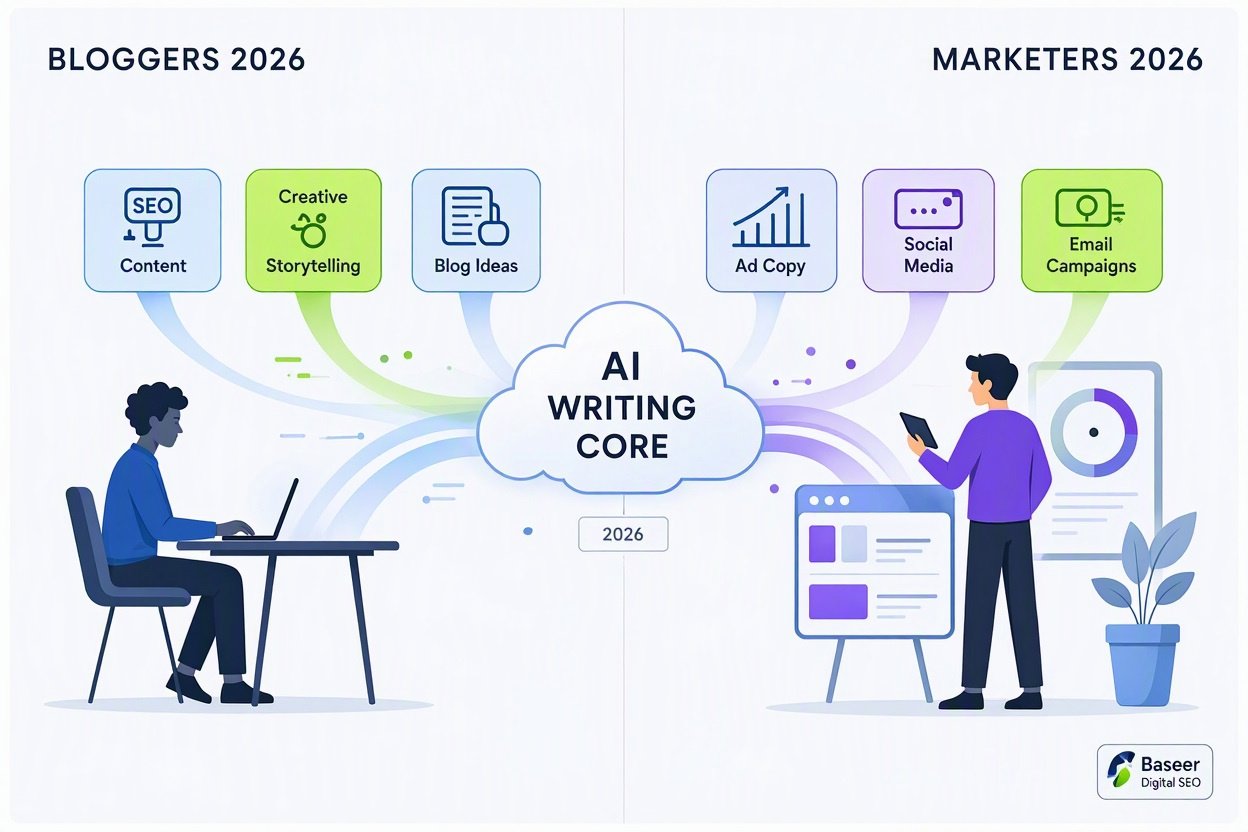
Creating high-quality content consistently is one of the biggest challenges for bloggers, SEO professionals, and digital marketers. Publishing one article occasionally is relatively easy. Producing blog posts, social media content, emails, product descriptions, ad copy, and marketing campaigns at scale requires much more time and planning.
This is where AI writing tools for bloggers and marketers can make a major difference.
Modern AI writing software can help with research, brainstorming, outlines, first drafts, content expansion, editing, repurposing, and optimization. However, the goal should not be to publish unlimited AI-generated text without review. The most effective workflow combines AI speed with human expertise, fact-checking, originality, and editorial judgment.
In this guide, we will explore the best AI writing tools for bloggers and marketers, how they can help scale content output, and how to maintain content quality while using AI.
Why AI Writing Tools Matter for Content Marketing
Traditional content production involves several stages:
- Topic research
- Keyword research
- Content planning
- Outlining
- Writing
- Editing
- SEO optimization
- Publishing
- Promotion
- Performance analysis
AI can assist with many of these tasks.
Instead of starting every article from a blank document, writers can use AI to generate ideas, organize information, create outlines, suggest headlines, rewrite sections, and develop content variations.
This can reduce repetitive work and give marketers more time to focus on strategy and creativity.
However, AI should be treated as a productivity assistant rather than a complete replacement for human writers.
Best AI Writing Tools for Bloggers and Marketers
The best tool depends on your workflow, budget, content type, and level of control.
Some platforms are designed as general AI assistants, while others focus specifically on marketing teams, SEO content, copywriting, or large-scale content production.
1. ChatGPT
ChatGPT is a flexible AI assistant that can support many parts of the blogging and marketing process.
Bloggers can use it for:
- Topic brainstorming
- Blog outlines
- First drafts
- Content expansion
- Rewriting
- Meta descriptions
- FAQ generation
- Social media posts
- Email drafts
- Content repurposing
- Research organization
- Content briefs
One of its biggest advantages is flexibility. You can provide detailed instructions about audience, tone, structure, keywords, and formatting.
For bloggers who produce multiple types of content, this flexibility can make ChatGPT a useful part of a broader content workflow.
2. Jasper
Jasper is designed heavily around marketing and brand content workflows.
It can be useful for teams working on:
- Marketing campaigns
- Blog content
- Advertising copy
- Social media
- Brand messaging
- Product marketing
- Content variations
Businesses that require consistent brand communication may find dedicated marketing workflows useful.
The important consideration is whether the platform’s features match your team’s actual content process rather than simply choosing a tool because it has a large feature list.
3. Writesonic
Writesonic focuses on AI-assisted content creation and marketing.
It can be useful for:
- Blog articles
- SEO content
- Marketing copy
- Landing page content
- Product descriptions
- Social media content
For marketers producing different content formats, having multiple templates and workflows in one platform can reduce repetitive setup work.
4. Grammarly
Grammarly is particularly useful for editing and improving written communication.
It can help writers review:
- Grammar
- Spelling
- Clarity
- Tone
- Conciseness
- Sentence structure
AI-generated drafts still need editing. An editing-focused tool can therefore complement a generative AI platform.
5. Copy.ai
Copy.ai is focused on marketing and business content workflows.
It can assist with tasks such as:
- Sales copy
- Marketing campaigns
- Social content
- Product descriptions
- Email content
- Business writing
For marketing teams, workflow-based AI tools can be useful when multiple people need to follow a consistent content process.
Image Caption: Using AI Writing Tools to Plan, Create, and Optimize Content

How to Scale Content Output With AI Writing Software
Scaling content does not simply mean producing more words.
A successful content operation needs a repeatable workflow.
Step 1: Build a Topic Database
Start by creating a list of topics related to your niche.
Organize topics into categories such as:
- Informational content
- Commercial content
- Comparison articles
- Product reviews
- Tutorials
- Case studies
- Industry news
- Frequently asked questions
AI can help brainstorm additional topics based on your existing content strategy.
Step 2: Create Content Briefs
Before generating an article, create a detailed brief.
A useful brief can include:
- Primary keyword
- Secondary keywords
- Search intent
- Target audience
- Recommended headings
- Questions to answer
- Internal links
- External sources
- Desired content length
- Tone of voice
A good brief gives the AI clearer instructions and reduces the amount of editing required later.
Step 3: Generate the First Draft
AI can create a first draft based on your brief.
Instead of asking for a generic article, provide detailed instructions.
For example, specify:
- Audience
- Region
- Tone
- Structure
- Keywords
- Examples
- Formatting requirements
The more relevant context you provide, the easier it becomes to edit the resulting content.
Step 4: Add Human Expertise
This is one of the most important steps.
Review the AI-generated content and add your own:
- Experience
- Examples
- Opinions
- Case studies
- Original insights
- Data
- Expert commentary
This makes the content more useful and differentiated.
Step 5: Edit and Optimize
After the draft is complete, review:
- Accuracy
- Readability
- Grammar
- Search intent
- Keyword placement
- Internal links
- Headings
- Meta title
- Meta description
- Originality
- Brand voice
AI can assist with editing, but final decisions should remain under human control.
Best AI Tools for Writing Long-Form SEO Blog Posts in 2026
Long-form SEO content requires more than generating a large number of words.
A useful SEO article should answer the reader’s question clearly while maintaining logical structure and useful information.
AI can help with:
- Topic clustering
- Search-intent analysis
- Outlines
- FAQ ideas
- Content expansion
- Internal-link suggestions
- Title variations
- Meta descriptions
- Content updates
However, writers should avoid producing long articles simply to reach a particular word count.
A 1,000-word article that completely answers a user’s question can be more useful than a 3,000-word article filled with repetition.
How to Scale Blog Traffic Using AI Content Generators
AI can support a larger publishing operation, but publishing more content does not automatically create more organic traffic.
A stronger strategy is to create content around a connected group of topics.
For example, a website about digital marketing could build clusters around:
- SEO
- Link building
- Content marketing
- AI marketing
- Technical SEO
- E-commerce SEO
You can then create pillar content supported by more specific articles.
AI can help generate topic ideas and organize the content structure, while human research determines which topics are actually valuable.
Update Existing Content
Content scaling does not always mean publishing new articles.
AI can also help identify opportunities to improve older content.
You can use it to:
- Rewrite outdated sections
- Identify missing subtopics
- Create new FAQs
- Improve introductions
- Generate updated meta descriptions
- Suggest internal links
- Refresh examples
Updating useful existing content can be an important part of a long-term SEO strategy.
Best AI Writing Assistants for Content Marketing Campaigns
Marketing teams often need more than blog posts.
A single campaign may require:
- Blog articles
- Email newsletters
- Social media posts
- Landing pages
- Ad copy
- Product descriptions
- Video scripts
- Promotional messages
AI writing assistants can help transform one core content asset into multiple formats.
For example, a detailed blog post can become:
- Five social media posts
- One email newsletter
- Several short-form video ideas
- A LinkedIn post
- FAQ content
- A downloadable checklist
This approach helps marketers increase content output without creating every asset completely from scratch.
Free and Paid AI Copywriting Tools for Digital Marketers
The choice between free and paid AI writing software depends on your workload.
Free AI Writing Tools
Free plans can be useful for:
- Beginners
- Occasional bloggers
- Freelancers testing AI workflows
- Simple brainstorming
- Short-form writing
However, free plans may have limitations involving usage, advanced features, automation, or access to certain models.
Paid AI Writing Tools
Paid platforms can be more useful for professional content operations.
Potential benefits include:
- Higher usage limits
- Advanced writing features
- Marketing templates
- Team collaboration
- Brand controls
- Workflow automation
- Additional integrations
Before subscribing, consider how frequently you will use the platform and whether its features actually save enough time to justify the cost.
ChatGPT vs Jasper vs Writesonic for Blogging
There is no universal winner because each platform can fit different workflows.
| Feature | ChatGPT | Jasper | Writesonic |
|---|---|---|---|
| General writing | Strong | Strong | Strong |
| Blog brainstorming | Strong | Strong | Strong |
| Marketing workflows | Flexible | Strong | Strong |
| Long-form content | Strong | Strong | Strong |
| Brand-focused workflows | Flexible | Strong | Available |
| Content repurposing | Strong | Strong | Strong |
| Beginner flexibility | High | High | High |
| Best use case | Versatile AI assistance | Marketing teams | Content and marketing production |
The right choice depends on your requirements rather than the number of features a platform offers.
If you need a flexible general-purpose assistant, ChatGPT may fit your workflow.
If your focus is heavily centered around marketing teams and brand workflows, Jasper may be worth evaluating.
If you want a content-production platform with multiple marketing-focused workflows, Writesonic can also be considered.
Always check current pricing, feature availability, usage limits, and integrations before making a purchasing decision.
Best AI Tools to Automate Content Production Workflow
AI becomes more useful when it is connected to a repeatable workflow, as explained in this content automation guide.
A basic content production system can look like this:
Topic Research → Content Brief → AI Draft → Human Editing → SEO Optimization → Visuals → Publishing → Promotion → Performance Review
Automation platforms can connect different parts of this process.
For example, a team might use automation to:
- Add new content ideas to a database
- Create content briefs
- Assign articles to writers
- Notify editors
- Track publishing status
- Organize content assets
- Schedule social promotion
The objective should be reducing repetitive administrative work while keeping important editorial decisions under human control.
How to Maintain Content Quality When Using AI Writers
Scaling content output creates one major challenge: quality control.
If you publish large amounts of AI-generated content without proper review, several problems can appear.
Check Facts
AI-generated content can contain incorrect or outdated information.
Verify important claims, statistics, product specifications, dates, and industry information before publication.
Avoid Generic Writing
Generic AI content often uses predictable phrases and repetitive explanations.
Improve it by adding:
- Real examples
- Original insights
- Specific recommendations
- Industry experience
- Useful data
- Unique comparisons
Maintain a Consistent Brand Voice
Create clear writing guidelines covering:
- Tone
- Vocabulary
- Sentence length
- Formatting
- Audience
- Brand personality
Then provide those guidelines to your AI writing workflow.
Add Original Value
Ask yourself:
What does this article provide that competing pages do not?
If the answer is unclear, the content probably needs more research, examples, experience, or analysis.
AI Content Workflow for Bloggers
A practical blogging workflow can be divided into seven stages.
1. Research
Identify the topic, audience, search intent, and relevant keywords.
2. Planning
Create the article outline and determine the information the reader needs.
3. AI-Assisted Drafting
Use AI to develop the initial content.
4. Human Editing
Check accuracy, tone, originality, and usefulness.
5. SEO Optimization
Optimize titles, headings, internal links, metadata, images, and relevant keywords naturally.
6. Publishing
Format and publish the article with appropriate visuals and supporting elements.
7. Performance Analysis
Monitor organic traffic, engagement, rankings, conversions, and other relevant metrics.
This workflow allows AI to accelerate production without removing human oversight.
Common Mistakes When Using AI Writing Tools
Publishing AI Content Without Editing
AI-generated drafts should normally be reviewed before publication.
Keyword Stuffing
Do not repeatedly insert the same keyword simply because you want to rank for it.
Use natural language and related concepts.
Ignoring Search Intent
An article can contain every target keyword and still fail to satisfy the reader.
Always determine what the searcher actually wants.
Producing Too Much Content
More content is not automatically better.
Focus on useful content that serves a clear purpose.
Forgetting Internal Linking
When scaling a website, connect related articles using relevant internal links.
This can help readers discover additional resources and can make your site structure easier to understand.
How Bloggers Can Use AI Without Losing Their Voice
AI should support your writing style rather than replace it.
A good workflow is to provide examples of your preferred writing style and then edit the output so it sounds natural.
You can also create a simple style guide containing:
- Preferred tone
- Words to use
- Words to avoid
- Formatting preferences
- Audience information
- Brand terminology
- Examples of good writing
This becomes especially useful for teams producing content across multiple writers.
Scaling Content for International Audiences
AI writing tools can also help marketers adapt content for different markets.
For example, a company targeting the:
- United States
- United Kingdom
- Canada
- Europe
may need different examples, terminology, spelling conventions, and search intent considerations.
UK audiences may expect British spelling, while US content may use American spelling.
Similarly, European businesses may have additional considerations involving privacy, localization, and regional regulations.
AI can help create variations, but each version should be reviewed by someone familiar with the target market.
Image Caption: Building a Scalable AI-Assisted Content Production Workflow

Final Thoughts
The best AI writing tools for bloggers and marketers can significantly improve the speed and efficiency of content production in 2026.
Tools such as ChatGPT, Jasper, Writesonic, Grammarly, and Copy.ai can support different parts of the writing and marketing process.
The biggest opportunity is not simply generating more articles. It is building a smarter content workflow where AI handles repetitive tasks while humans provide strategy, expertise, creativity, fact-checking, and editorial judgment.
If you want to scale content successfully, start with a clear content strategy, create detailed briefs, use AI for production assistance, edit every important piece, optimize for search intent, and continuously measure performance.
That combination can help bloggers and marketers increase content output while maintaining the quality readers and search engines expect.
SEO Keywords
Primary Keywords:
- Best AI writing tools for bloggers and marketers
- How to scale content output with AI writing software
- Top AI content creation tools for digital marketing
Long-Tail & Intent Keywords:
- Best AI tools for writing long-form SEO blog posts in 2026
- How to scale blog traffic using AI content generators
- Best AI writing assistants for content marketing campaigns
- Free and paid AI copywriting tools for digital marketers
Tool & Workflow Keywords:
- ChatGPT vs Jasper vs Writesonic for blogging
- Best AI tools to automate content production workflow
- How to maintain content quality when using AI writers





Leave a Reply