
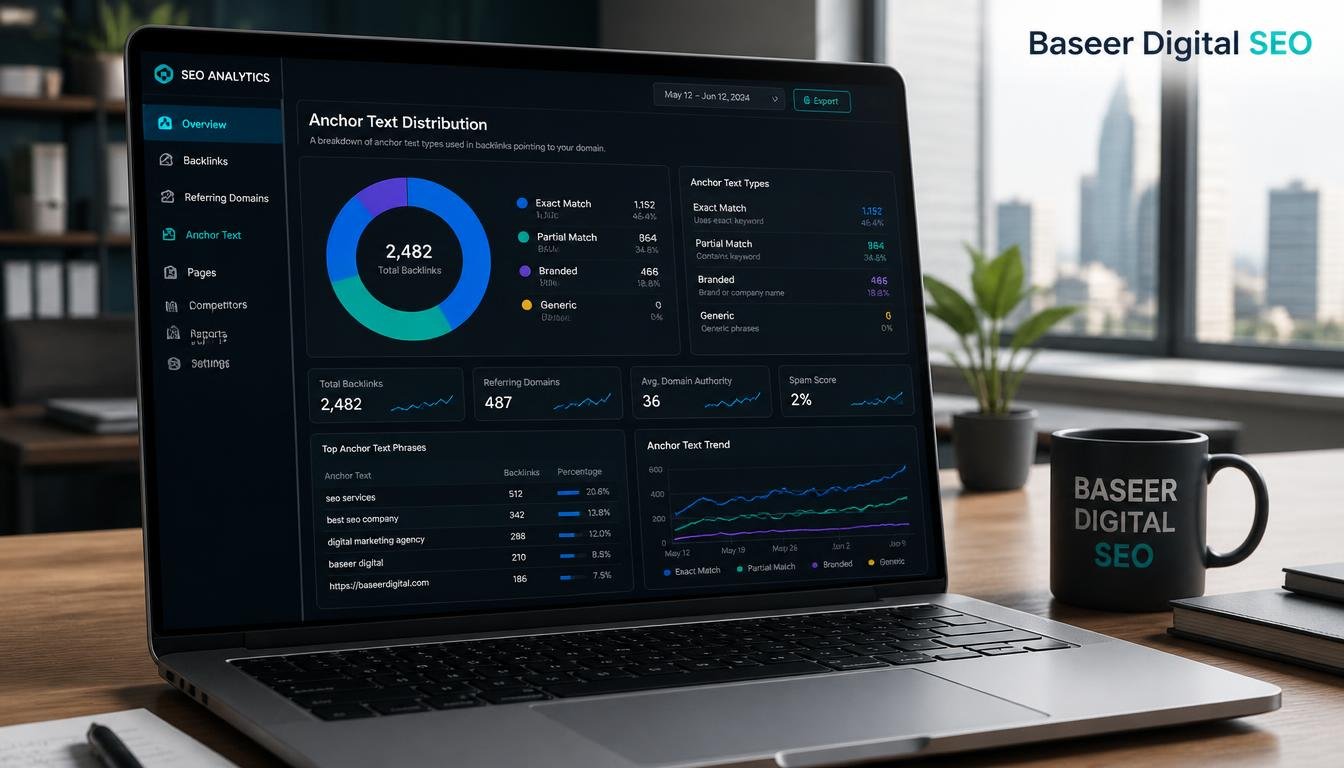
If you’ve ever clicked a blue, underlined phrase on a web page, you’ve used anchor text. It looks like a small detail, but it shapes how readers move through your site and how Google understands the pages you link to.
This guide covers anchor text in SEO from the ground up: what it is, how the main types work, how it influences rankings, and how to use it without triggering penalties. It’s written for marketers, site owners, and content teams in the US, UK, and Canada who want links that help both people and search engines.
What Is Anchor Text?
If you’re asking what is anchor text, the short answer is this: anchor text is the visible, clickable wording of a link. In HTML, it’s the text between the opening and closing link tags. Readers see it as hyperlink text, usually underlined or colored differently from the surrounding copy.
Search engines read that wording as a clue about the destination page. A link reading “email marketing checklist” tells Google, and the reader, what to expect on the other side. A link reading “click here” tells them almost nothing.
Anchor text appears in three main places:
- Internal links between pages on your own site
- Backlinks from other websites pointing to yours
- Navigation and footer links that use short labels

Types of Anchor Text
Knowing the types of anchor text helps you plan links deliberately instead of by instinct. Most SEO professionals group them into the categories below.
Exact Match Anchor Text
Exact match anchor text uses the precise keyword the target page wants to rank for. For a page about running shoes, the anchor would be “running shoes.” It sends a clear relevance signal, but repeating it too often looks manipulative.
Partial Match Anchor Text
Partial match anchor text includes the target keyword inside a longer, more natural phrase, such as “how to choose the best running shoes for beginners.” It stays relevant while reading like normal language, so it’s usually safer and more flexible than an exact match.
Branded Anchor Text
Branded anchor text uses a company, product, or person’s name, for example “Moz” or “Shopify.” Branded links are among the most natural patterns in a healthy profile because real people link to brands by name.
Naked URL Anchor Text
Naked URL anchor text is a bare web address, like https://www.example.com. These links are common in citations, press mentions, and social posts, and they add authentic variety.
Generic Anchor Text
Generic anchor text covers phrases such as “click here,” “read more,” or “this website.” It carries little context, so it’s best kept to a minimum, especially in internal linking.
Image Links and Alt Text
When an image is the clickable element, there’s no visible text to read. In that case, image alt text for links works as the anchor. Descriptive alt text lets search engines and screen readers understand where the link leads, so write it as carefully as you would any text link.
How Anchor Text Affects Google Rankings
The relationship between anchor text and Google rankings is real but easy to overstate. Google has said publicly that link text helps it understand what a page is about. Its SEO documentation recommends link text that is descriptive and reasonably concise.
Here’s how it plays out in practice:
- Relevance signals. Descriptive anchors help Google connect a linked page with specific topics.
- Context for crawlers. Anchors help crawlers interpret how pages relate to each other across a site.
- User experience. Clear links help readers decide whether to click, which supports engagement.
When people discuss search engine algorithms and anchor text, the key moment is Google’s Penguin update, introduced in 2012, which targeted manipulative link patterns, including heavily repeated keyword-rich anchors. Since then, Google’s systems have grown better at spotting unnatural link behavior, and its spam policies explicitly cover link schemes.
So anchor text still matters, but no one outside Google knows exactly how much weight any signal carries, and that weighting can change. Treat anchor text as one input among many, alongside content quality, page experience, and the authority of the linking site.

Anchor Text Optimization Best Practices
Good anchor text optimization isn’t about squeezing keywords into every link. It’s about clarity, relevance, and variety. These anchor text best practices apply whether you’re doing internal linking SEO or SEO link building across other sites.
Use Descriptive and Relevant Text
Your anchor should tell someone what they’ll find before they click. Compare these examples:
| Weak anchor | Stronger anchor |
|---|---|
| Click here | our guide to first-time home buyer mortgages |
| Read more | tips for filing self-assessment tax returns |
| This page | Canadian small business grant programs |
A useful test: if the link were read aloud out of context, would it still make sense? That’s also what screen reader users hear, so descriptive links improve accessibility as well as SEO.
For internal links, descriptive anchors help you reinforce topic clusters. Linking from a broad guide to a detailed supporting article with a precise phrase shows both users and crawlers how your content fits together.
Maintain Natural Anchor Text Diversity
Anchor text diversity means using a healthy mix of anchor types rather than repeating one phrase. Real-world links come from many writers using many wordings, and your profile should look the same.
For anchor text for backlinks, you rarely control the exact wording anyway. Editors, bloggers, and journalists choose their own phrasing. What you can control is the quality of the page being linked and how you describe it in outreach and on your own site.
Balancing Branded and Keyword-Rich Anchors
There’s no official ideal ratio, and anyone quoting an exact percentage is guessing. A sensible approach for most sites:
- Let branded anchor text and naked URLs make up a large share of external links. These patterns occur naturally.
- Use partial match anchor text more often than exact match.
- Reserve exact match for places where it reads naturally.
- Keep generic anchors to a small portion.
Smaller or newer sites should be especially careful. A profile dominated by exact-match anchors looks engineered, no matter how good the target page is.
Reviewing Your Backlink Anchor Profile
A periodic audit helps you catch problems early. Here’s a simple process:
- Export your backlinks from Google Search Console, which lists top linking text under its Links report, or from a third-party SEO tool.
- Group the anchors into the categories above.
- Look for any single exact-match phrase that appears far more than the rest.
- Check whether suspicious links come from low-quality or irrelevant sites.
- Document what you find and decide whether to request changes, build more varied links, or disavow only truly harmful ones.
Google has said most sites don’t need the disavow tool, so use it sparingly and only for clear cases of spammy links you can’t get removed.

Avoid Keyword Stuffing and Over-Optimization
Anchor text over-optimization happens when a site pushes the same keyword-rich phrase into too many links, internally or externally. It can look like an attempt to manipulate rankings, which conflicts with Google’s spam guidelines.
To stay safe:
- Write the sentence first, then add the link where it fits.
- Vary the wording of internal links to the same page.
- Don’t let money keywords dominate your anchor mix.
- Avoid paid or traded links that pass along forced anchor wording.
- Keep anchors short, ideally a few words rather than a full sentence.
If a link feels awkward when you read it aloud, it will feel awkward to your audience, too.
Common Anchor Text Mistakes to Avoid
Even experienced teams slip up. Watch for these frequent issues:
- Overusing exact match anchors. Repeating the same phrase across many links is the fastest route to an unnatural profile.
- Relying on generic text. “Click here” wastes a chance to add context.
- Using the same anchor for different pages. This confuses relevance and can cause pages to compete with each other.
- Linking long, rambling phrases. Anchors that swallow whole sentences are hard to scan.
- Ignoring image links. Missing or vague alt text means the anchor has no meaning for search engines or assistive tools.
- Forgetting link context. The surrounding sentence matters, so make sure the link sits in text that genuinely relates to the destination.
- Buying links for specific anchors. Paid links that pass ranking signals can violate Google’s guidelines and put your site at risk. Use proper link attributes where required.
- Never reviewing existing links. Old redesigns, migrations, and outdated pages can leave broken or mismatched anchors behind.
Frequently Asked Questions About Anchor Text
What is anchor text in simple terms?
It’s the clickable words in a link. Those words tell readers and search engines what the linked page is about.
Does anchor text still matter for SEO in 2026?
Yes, but it works as a supporting signal, not a shortcut. Descriptive links help with relevance and usability, while quality content and trustworthy backlinks do most of the heavy lifting.
What is the best type of anchor text?
No single type wins. A natural mix of branded, partial match, naked URL, and a small amount of exact match and generic text looks the most realistic.
How many times can I use an exact match anchor?
There’s no official limit. Use it only when it reads naturally, and rely more on varied, descriptive phrasing.
Is anchor text important for internal links?
Very. Internal linking SEO lets you guide crawlers and readers through related content with precise, descriptive wording, which you fully control.
Can I change anchor text on backlinks I already have?
Sometimes. You can politely contact the site owner, but many won’t update links, so focus on earning new, varied links rather than chasing edits.
How do I check my anchor text profile?
Use Google Search Console’s Links report or a trusted SEO platform to review which phrases other sites use when linking to you.
Conclusion
Anchor text is simple in concept and powerful in execution: clear, relevant, varied link wording helps readers navigate and helps search engines understand your content. The strongest approach is a balanced one. Write for people first, mix your anchor types, keep internal links descriptive, and review your backlink profile now and then.
Make each link earn its place, and your anchor text will support your rankings instead of putting them at risk.






Leave a Reply