
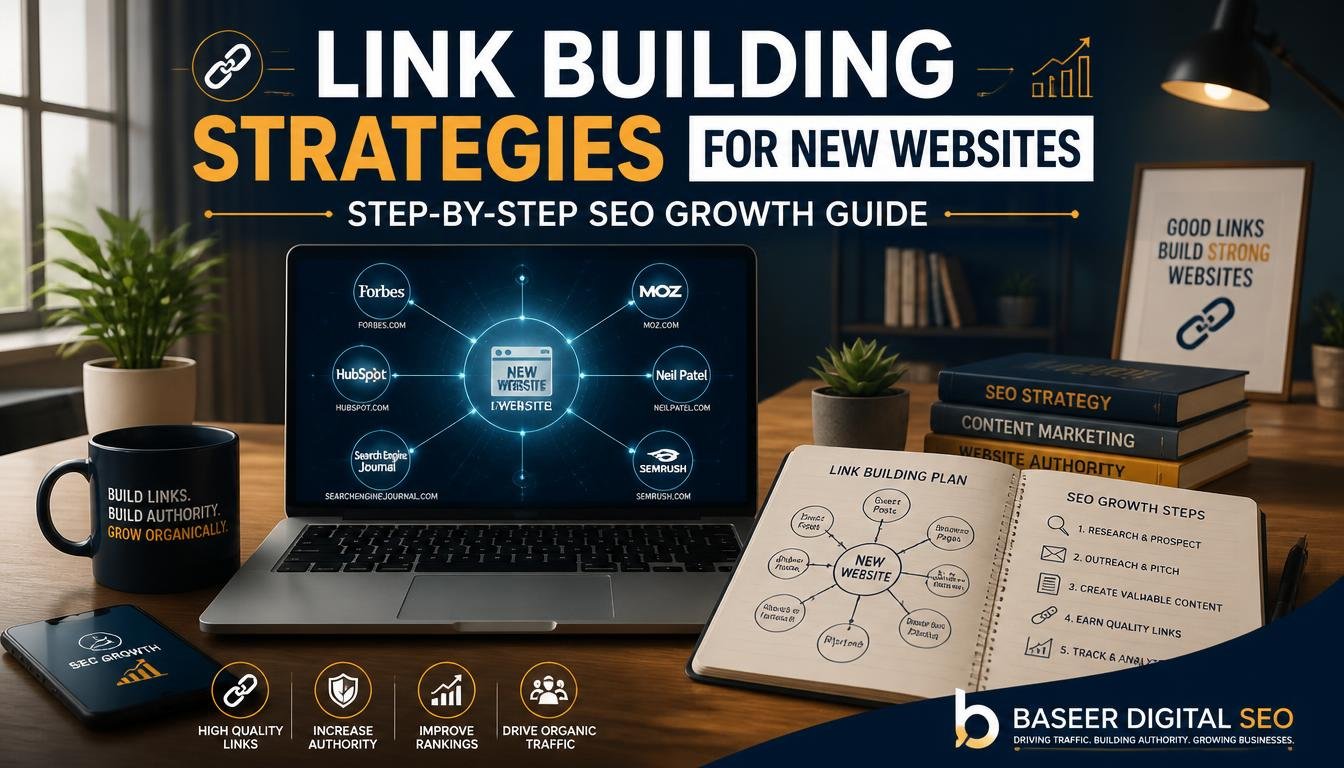
Introduction: Why Link Building Matters for New Websites
Picture a bike repair shop in Denver that launches a polished website with useful service pages and a few helpful blog posts. Three months later, it is still struggling to appear for competitive searches. The content may be solid, but the business is new, few people know its resources exist, and other relevant sites have not had many opportunities to reference them. Links are only one possible factor; search intent, competition, technical health, and content quality matter too.
That is the practical challenge behind link building strategies for a new website: you may have useful content, but publishers and potential visitors have not discovered it yet. Many guides assume an established brand, an existing audience, or a sizeable outreach budget. A new site often has to build visibility and relationships from a much smaller starting point.
This guide covers link building for SEO from the ground up. You’ll learn what backlinks actually do, which tactics suit a site that’s only a few weeks old, which ones to save for later, and how to follow a simple 30-day plan. Nothing here promises quick rankings. Links take time, and anyone who tells you otherwise is selling something.

What Is Link Building in SEO?
Link building is the practice of earning links from other websites to your own. Those links, called backlinks, work like recommendations. When a respected site points to yours, it signals that your page is worth visiting.
SEO link building isn’t about collecting as many links as possible. It’s about earning the right ones, from relevant, trustworthy sites, in a way that looks natural over time.
How Backlinks Help Search Engines Discover New Websites
Search engines can discover pages by following links from one page to another. External links may help discovery, but they do not guarantee crawling or indexing. For a new site, submit a sitemap through Google Search Console, use sensible internal links, and make sure important pages are accessible and indexable.
Links also act as one of many signals that help search engines judge how credible and relevant a page is. They’re not the only signal, but they’re an important one.
The Difference Between Backlinks and Referring Domains
A backlink is a single link pointing to your site. A referring domain is a unique website that links to you. If one blog links to you 40 times across its pages, you have 40 backlinks but only one referring domain.
That distinction matters. Links from several relevant, independent sites can broaden your reach, although quality and context matter more than a simple count. Track both backlinks and referring domains, and review the actual pages linking to you.
Why New Websites Need a Link Building Strategy
Established sites pick up links passively through years of visibility, press mentions, and word of mouth. A new site doesn’t have that momentum, so it needs a deliberate plan.
Building Authority and Trust Gradually
Trust and reputation are built over time through useful content, positive user experiences, relevant mentions, and editorially earned links. No single link or third-party metric can switch authority on overnight. Focus on earning links because the content is useful, not on hitting an arbitrary monthly quota. A burst of links is not automatically a problem; what matters is whether the links were earned naturally or created through manipulative tactics.
Setting Realistic Expectations for SEO Results
For most new sites, meaningful movement takes months, not days. Competition, niche, content quality, and site health all affect the timeline. Some links won’t change much on their own, and some pages will rank with very few links if the topic isn’t competitive.
Treat link building as one part of a broader SEO effort alongside good content and a technically sound site.
Beginner Link Building Strategies for New Websites
If you’re just starting out, focus on methods that don’t require an existing audience or a big budget. These beginner link building strategies are low-risk, and they build habits you’ll use for years.
Create Helpful, Link-Worthy Content
People link to pages that solve a problem, answer a question clearly, or offer something they can’t easily find elsewhere. Before publishing, ask whether another site owner would have a reason to reference the page. A Toronto renovation contractor, for example, might publish a plain-language guide to permit requirements for basement conversions. That’s far more likely to attract links than a generic “top 10 home tips” post.
Find Unlinked Brand Mentions
Sometimes people already mention your business or founder without linking to you. Search your brand name in quotation marks, or set up a free Google Alert, and look for pages that name you without a link.
When you find one, send a short, friendly email thanking them for the mention and asking whether they’d consider adding a link. Unlinked brand mentions are among the easiest wins because the writer already knows who you are.
Use Relevant Business and Industry Directories
Reputable directories can provide a few early links and help establish your business details across the web. In the US, that might mean your local chamber of commerce or the Better Business Bureau. UK businesses might use Yell or a trade association listing, and Canadian businesses might look at Yellow Pages Canada or a provincial industry body.
Skip anything that exists purely to sell links. If a directory accepts every submission with no review, it’s probably not worth your time.
Build Relationships in Your Niche
Many of the best links start with a conversation. Comment thoughtfully on blogs you read, share other people’s work, join industry communities, and introduce yourself to site owners before you need anything. It feels slower than a cold pitch, but it works because people link to those they know and trust.
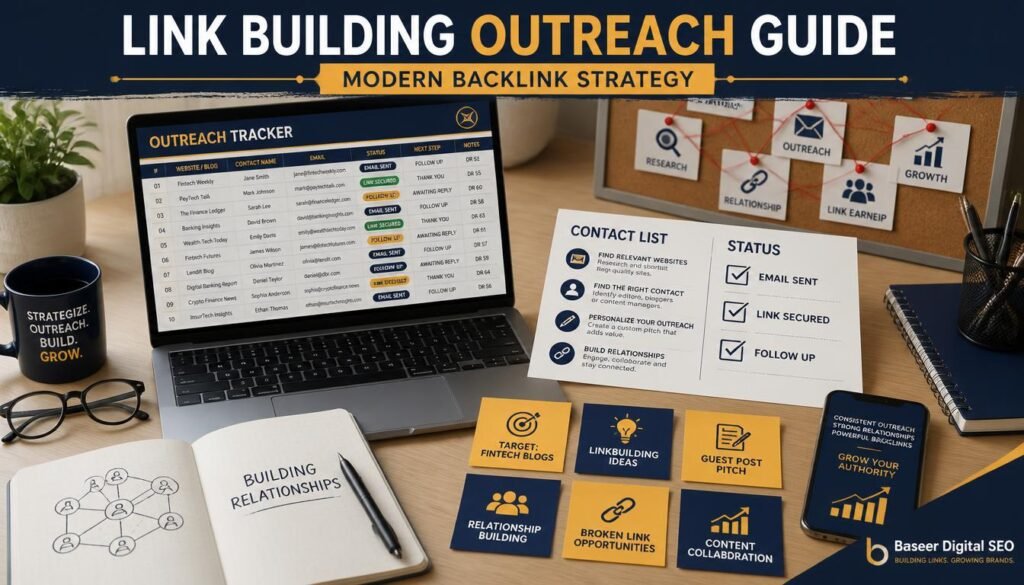
Guest Posting and Blogger Outreach
Guest posting can help you reach a relevant audience when the host publication genuinely values the contribution. Prioritize a useful article, editorial fit, and real readers rather than treating guest posts as a way to place keyword-rich links. Links that are paid for or exchanged to manipulate rankings can violate search engine spam policies and may need appropriate qualification.
How to Find Relevant Guest Posting Opportunities
Start with sites your target customers already read. Search for phrases like “write for us” alongside your topic, look at where competitors have contributed, and check which blogs in your niche publish outside authors.
Build a short list of 20 to 30 sites, and read their recent posts before pitching. If a site hasn’t published anything in months or accepts anything that’s submitted, move on.
Writing Personalized Blogger Outreach Emails
Good blogger outreach is short and specific. Mention a recent post you liked, explain who you are in a sentence, and propose two or three topic ideas that suit their readers. A pitch could read: “I enjoyed your piece on winter commuting. I run a bike repair shop in Denver and could write a practical guide to cold-weather bike maintenance. Would that interest your readers?”
Avoid copy-and-paste templates with only the name swapped out. Editors can spot them quickly.
A simple outreach email can follow this structure:
Subject: Resource idea for your guide to [topic]
Hi [Name],
I was reading your page about [specific topic] and noticed you reference resources that help readers [specific goal]. We recently published [brief description of your resource], which may be useful to your audience because [specific reason].
Here is the page if you would like to review it: [URL]
Either way, thanks for putting the guide together.
Best,
[Your Name]
Personalize every message, describe the resource honestly, and accept that the editor may decide it is not a fit.
Evaluating Website Quality Before Pitching
Before you invest time in a pitch, check whether the site is worth it:
- Does it have real, engaged readers and original content?
- Is it relevant to your topic?
- Does it publish a mix of authors, or is it a content farm?
- Does it link out to reputable sources?
A link from a small but respected niche blog usually beats one from a large site with no editorial standards.
Broken Link Building and Resource Page Link Building
These two tactics are closely related, and both suit new sites because they offer something useful to the site owner instead of just asking for a favor.
Finding Broken Links on Relevant Websites
Broken link building starts with finding pages in your niche that link to resources that no longer exist. Browser extensions like Check My Links can scan a page quickly, and tools such as Ahrefs or Semrush can surface broken outbound links across a whole site. Focus on pages that are relevant to your topic and actively maintained.
Creating a Useful Replacement Resource
If the dead page covered something you can explain well, write a better, up-to-date version on your own site. If you already have a suitable page, you can use that. The replacement needs to genuinely fill the gap, or your outreach will feel like a sales pitch.
Pitching Resource Pages Naturally
Resource page link building works the same way. Many sites keep curated lists of helpful tools, guides, and references. Find ones in your niche, and if your content genuinely fits, send a brief note.
A good message mentions the broken link or the list gap, points to your resource, and leaves it to them. Don’t pressure anyone. A polite follow-up after a week or so is plenty.
Competitor Backlink Analysis for New Websites
Competitor backlink analysis shows you where similar sites earned their links, which tells you what’s realistic in your niche. You don’t need to copy anything. You’re looking for patterns.
Identify Competitors with Similar Content
Don’t start with the biggest brand in your industry. Look for sites targeting similar search terms and audiences, ideally at a similar size or only slightly ahead. Their backlink profiles will be far more useful than those of a national publisher.
Find Realistic Backlink Opportunities
Using a tool such as Ahrefs, Semrush, or Moz Link Explorer, review who links to those competitors. Look for sites that link to several competitors but not to you. These “link gap” opportunities usually show editors who are already interested in your topic.
Prioritize Relevance Over Metrics Alone
Metrics such as Domain Rating, Domain Authority, and similar scores are third-party estimates, not Google ranking factors. A relevant local publication with a modest score may send interested visitors and provide meaningful context, while a high-scoring site unrelated to your topic may be a poor fit. Evaluate relevance, editorial standards, real audience, and the linking page—not a score alone.

Linkable Content and Content Marketing for Backlinks
Content marketing for backlinks works when the content gives people a reason to cite it. Linkable content tends to share a few traits: it’s accurate, clearly organized, and useful enough that someone writing on the topic would want to reference it.
Publish Original Research, Statistics, and Guides
Original data is one of the strongest link magnets, but it doesn’t have to be a huge study. A small survey of your own customers, an analysis of your own business data, or a well-researched guide that pulls information together in one place can all earn citations. Be transparent about your methods, and never invent figures.
Create Useful Tools, Templates, and Visual Assets
A free calculator, a downloadable checklist, a spreadsheet template, or a clear infographic gives people something to bookmark and share. A UK accountancy start-up, for instance, could offer a simple self-assessment deadline checklist. Make it good enough that it solves a real problem on its own.
Promote Content Without Spamming
Publishing isn’t enough, since nobody finds a new site’s content by accident. Share it with people who’d genuinely benefit, such as newsletter writers, community moderators, and bloggers who’ve covered the topic before. Send one thoughtful message, not a blast to hundreds of strangers.
Digital PR and Advanced Link Building Strategies
Advanced link building strategies tend to demand more time, credibility, or assets. They’re not off-limits for new sites, but they make more sense once you have something worth talking about.
Share Expert Insights with Journalists and Publishers
Digital PR link building often starts with responding to journalists who need expert commentary. Platforms like Qwoted and Featured connect sources with reporters, and you can also pitch local news outlets directly. If you run a small business in Manchester or Vancouver, regional publications often welcome local expertise. Be concise, answer the question asked, and make the reporter’s job easy.
Build Relationships Before Asking for Links
Journalists and editors hear from hundreds of people. The ones who get quoted are usually those who’ve been helpful before. Follow reporters in your field, share their work, and respond when you actually have something useful to say.
When Advanced Tactics Make Sense for a New Website
A new site doesn’t need to do everything at once. Here’s a rough guide:
| Technique | Best stage | Effort level |
|---|---|---|
| Unlinked brand mentions | Brand new | Low |
| Relevant directories | Brand new | Low |
| Guest posting | First few months | Medium |
| Broken link building | First few months | Medium |
| Original research | Once you have content and an audience | High |
| Digital PR campaigns | Once you have something newsworthy | High |
How to Earn High-Quality, Niche-Relevant Backlinks
High-quality backlinks and niche-relevant backlinks share one characteristic: they make sense. A site that covers your topic, has real readers, and links to you because your page is useful is the ideal scenario.
Assess Topical Relevance and Editorial Standards
Before pursuing any link, ask:
- Does this site cover a topic close to mine?
- Is there real editorial oversight, or can anyone publish anything?
- Would I be proud to have my brand associated with it?
If the answer to the third question is “not really,” skip it.
Understand Anchor Text and Natural Link Placement
Anchor text is the clickable wording of a link. Natural links use a mix: your brand name, the page title, a plain URL, or a descriptive phrase. If every link uses the exact same keyword-heavy phrase, it can look manipulated. Don’t ask editors to use specific anchor text, and let the context guide it.
Recognize Link Spam Risks and Paid-Link Concerns
White-hat link building focuses on earning editorially justified links rather than manipulating rankings. Google’s spam policies identify link schemes—including buying or selling links for ranking purposes—as a violation. For advertising or paid placements, use an appropriate link qualification such as rel=”sponsored” (rel=”nofollow” may also be acceptable in some cases). A vendor promising a large bundle of guaranteed ranking backlinks deserves careful scrutiny.
Common Link Building Mistakes New Websites Should Avoid
Most early link building problems come from impatience. Avoiding these three saves a lot of cleanup later.
Buying Manipulative Links or Using Link Schemes
Private blog networks, large-scale reciprocal link schemes, and paid placements disguised as independent editorial recommendations can expose a site to search-engine action or cause the links to be ignored. They may also bring little relevant referral traffic. Avoid tactics designed primarily to manipulate rankings.
Sending Generic Mass Outreach
Mass email campaigns can be ignored, reported as spam, or damage your reputation. A smaller, carefully researched list makes it easier to explain why each publication is a genuine fit. Follow applicable email and privacy rules in your target market, and do not keep contacting people who decline.
Chasing Domain Metrics Instead of Real Value
It’s tempting to chase the highest score on the list. But a link on a high-scoring site that has nothing to do with your topic offers little. Ask whether the link could send real visitors, and whether it makes sense for that page.
How to Measure Link Building Progress
Link building feels slow, so tracking helps you see what’s working.
Track Referring Domains and Quality Backlinks
Keep a simple spreadsheet recording each link, the referring site, the date, and how you earned it. Look at the number of new referring domains over time, and also check whether they’re relevant and credible. Google Search Console provides a free links report, although it is not a complete, real-time inventory of every link. Paid tools can offer additional discovery and comparison features.
Monitor Organic Visibility and Relevant Traffic
Watch impressions, clicks, and rankings for the pages you’re promoting. Also look at referral traffic in your analytics. A link that sends a few interested visitors can be worth more than one that sends none.
Review and Improve Your Strategy Over Time
Every month or two, look at which techniques produced links and which wasted effort. If guest posts convert well but directory listings do nothing, shift your time. Your strategy should change as your site grows.
A Practical 30-Day Link Building Plan for a New Website
This plan assumes you have a handful of published pages and around five hours a week to spare.
Week 1: Prepare Link-Worthy Content and Target Lists
Choose one or two pages worth promoting and improve them. Set up Google Alerts for your brand name, and create a spreadsheet for outreach targets. Add 20 relevant blogs, resource pages, and local directories to it. Check your site’s basics too, including titles, speed, and mobile layout, so visitors who arrive from links have a good experience.
Week 2: Start Outreach and Relationship Building
Submit your business to three or four reputable directories. Send personalized pitches to five or ten sites on your list, whether for guest posts or for resource pages. Begin engaging in one or two industry communities, and follow a few journalists in your niche.
Week 3: Promote Resources and Follow Up Thoughtfully
Share your best content with the people who’d benefit from it. Follow up once on any outreach that hasn’t had a response, and keep it friendly and brief. Reach out about any unlinked brand mentions you’ve found.
Week 4: Review Results and Plan the Next Steps
Record new backlinks and referring domains, but judge them by relevance and quality as well as quantity. Check referral visits, outreach replies, and the organic performance of the pages you are promoting; changes in rankings can have multiple causes. Decide what to repeat and what to drop. Then plan the next month, perhaps adding one larger piece such as a small survey or a free template.
Frequently Asked Questions
How many backlinks does a new website need?
There is no ideal number. The right target depends on the topic, competition, and the quality of the pages you want to rank. Focus on earning relevant links that make sense for readers instead of chasing a quota.
Should a new website buy backlinks?
Avoid buying links intended to manipulate search rankings. Paid advertising and sponsorships can be legitimate marketing activities, but links should be appropriately qualified and should not be presented as independent editorial endorsements.
How long does link building take to show results?
There is no fixed timeline. Discovery, crawling, ranking changes, and referral traffic can develop at different speeds. Review progress over several months and consider content quality, competition, and technical SEO alongside links.
Can a website rank without backlinks?
Yes, some pages can rank without many external links, especially for less competitive searches or when they satisfy the query particularly well. Backlinks are one part of SEO, not a guarantee or a prerequisite for every ranking.
Conclusion: Build Backlinks Consistently and Naturally
New sites don’t win at link building by doing everything at once. They win by publishing genuinely helpful content, reaching out to the right people, and doing it steadily for months. Start with the simple tactics, such as brand mentions, relevant directories, and thoughtful outreach, then move toward research and digital PR as your site earns more credibility.
Keep the focus on relevance and real relationships, and stay on the right side of search engine guidelines. Links earned that way tend to last, and they’re the ones that help a new website grow.


Leave a Reply