
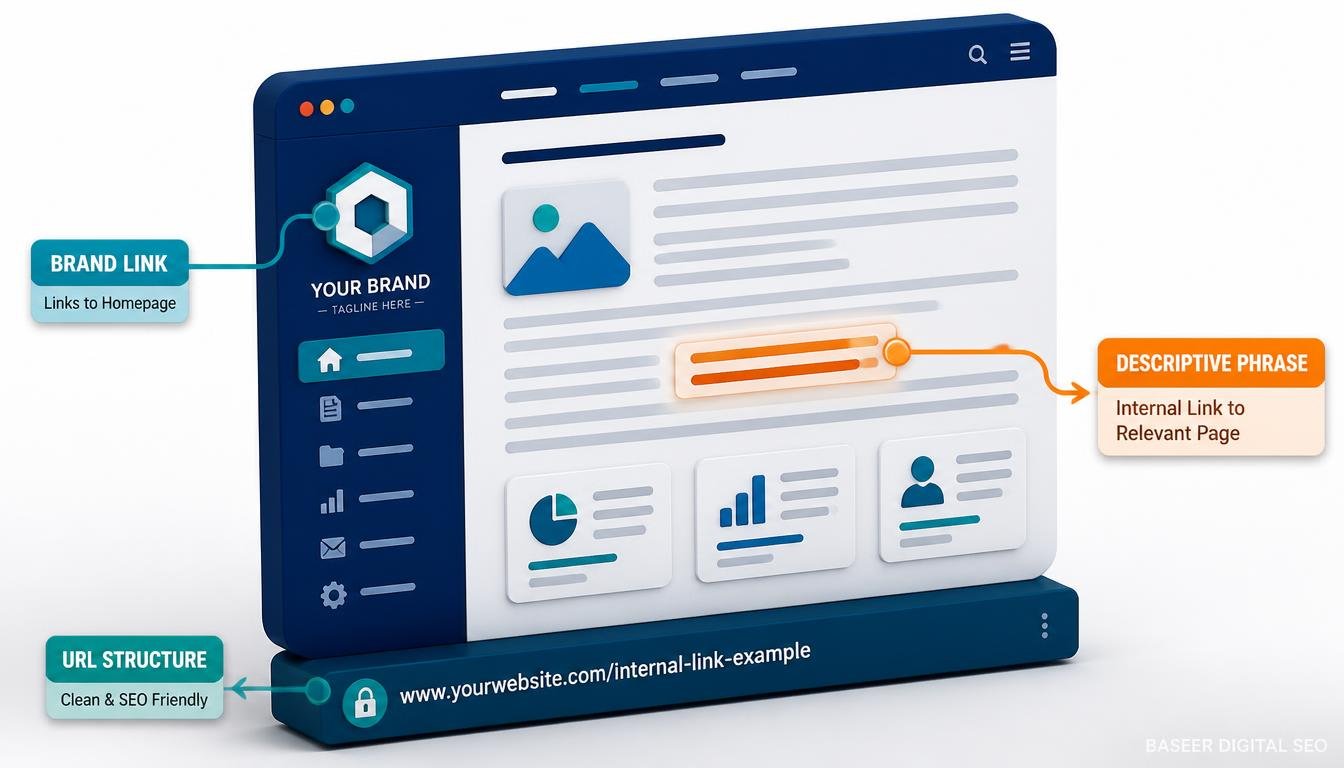
Picture a Toronto accounting firm earning a backlink from a respected small-business blog. The blogger could use “click here,” paste the company’s URL, or link the words “bookkeeping for freelancers.” All three options create a clickable link, but each communicates something different to readers and search engines.
The right choice depends on the page being linked, the surrounding content, and the reason the link exists. A clear, relevant anchor helps readers understand what to expect. An awkward or misleading one can interrupt the reading experience and make a backlink appear overly promotional.
This guide explains how to choose anchor text for backlinks, the different types of anchor text, practical examples, and common mistakes to avoid. Whether you’re managing an SEO campaign in the United States, building links for a UK business, or improving a Canadian company’s backlink profile, the goal is the same: earn relevant links that make sense to real readers.
What Is Anchor Text and Why Does It Matter for Backlinks?
Anchor text is the visible, clickable wording of a hyperlink. In HTML, it appears between the opening and closing anchor tags. Readers typically recognize it through a different color, an underline, or another visual treatment that distinguishes it from surrounding text.
For example, consider this sentence:
“Read our guide to small business accounting software before choosing a platform.”
If those bold words link to a page comparing accounting software, they are the anchor text.
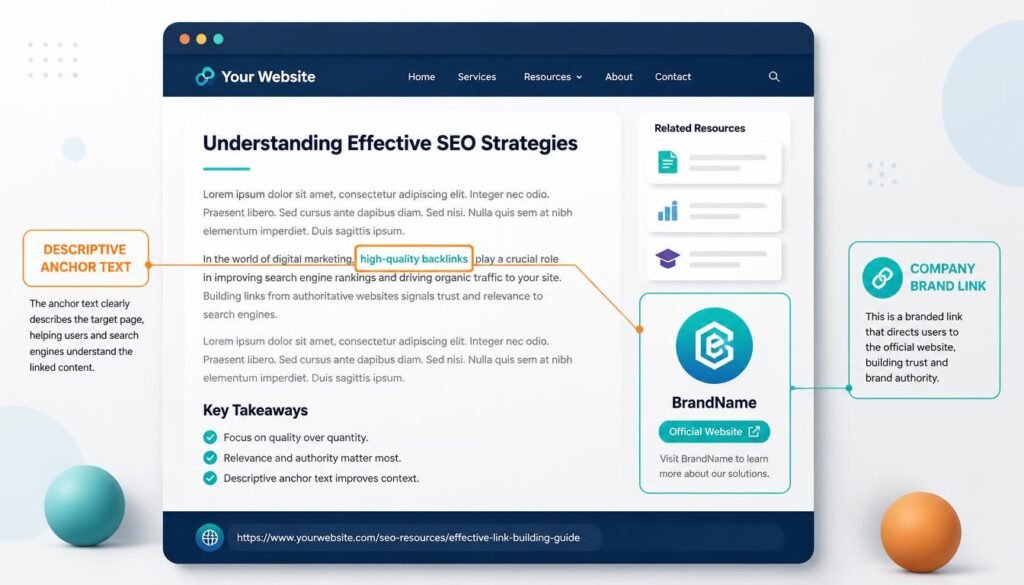
Anchor text provides context about the destination. A descriptive phrase sets clearer expectations than a vague instruction such as “click here.” This is why anchor text optimization is an important consideration in SEO and link building.
However, anchor text is only one part of a backlink’s value. The relevance of the linking page, the quality of its content, the link’s placement, and the usefulness of the destination all matter.
How Anchor Text Works in SEO
Anchor text helps readers and search engines understand the relationship between a link and its destination. Google uses anchor text, along with surrounding content and other signals, to understand linked pages.
Imagine a US software company publishes a guide to project management. A relevant article links to it using the phrase “project management software comparison.” That wording gives readers a reasonable idea of what they will find after clicking.
Now imagine the same article links to an unrelated page using “best mortgage rates.” The wording creates an expectation the destination cannot satisfy.
The first example provides useful context. The second creates confusion.
Anchor text should therefore describe the destination accurately rather than simply repeat a target keyword. There is no single phrase that guarantees higher rankings, and changing anchor text alone cannot compensate for a poor-quality page or an irrelevant backlink.
The Relationship Between Anchor Text and Backlink Quality
Backlink anchor text contributes context, but it does not automatically make a link valuable.
A link from an irrelevant, low-quality page does not become trustworthy simply because it uses a well-chosen keyword. Likewise, a relevant editorial link may be useful even when the anchor is a brand name or a natural description rather than an exact-match keyword.
When evaluating a backlink, consider:
- Topical relevance: Does the linking page discuss a related subject?
- Editorial context: Does the link genuinely help the reader?
- Source quality: Is the linking website a credible, useful resource?
- Destination relevance: Does the target page deliver what the anchor promises?
- Placement: Does the link fit naturally into the content?
- Link attributes: Is the link editorial, sponsored, or otherwise qualified appropriately?
A good backlink should make sense without relying on keyword-rich wording to justify its existence.
How Search Engines Interpret Link Context
Search engines can consider the anchor text alongside the sentences around the link, the topic of the linking page, and the content of the destination page.
For instance, the phrase “compare business insurance policies” is more informative when it appears in a paragraph explaining insurance options than when it appears in an unrelated footer.
This is why context matters. The anchor should complement the surrounding sentence, not carry the entire meaning of the link by itself.

Different Types of Anchor Text for Backlinks
Understanding the main types of anchor text helps you assess existing backlinks and choose suitable wording for new links. Each type has a different purpose, and a natural backlink profile can contain a mixture of them.
Exact Match Anchor Text
Exact match anchor text uses the precise target keyword or phrase associated with the destination page.
For example, a link to a page about furnace repairs might use “furnace repair Chicago.”
This can be appropriate when the wording genuinely fits the sentence. However, repeatedly requesting the same commercial phrase across many backlinks can make a link-building campaign appear manipulative.
Use exact-match wording when it reads naturally, not simply because it matches a keyword target.
Partial Match Anchor Text
Partial match anchor text includes a target keyword within a longer phrase.
For example:
- “A practical guide to furnace repair in Chicago”
- “Learn more about choosing a furnace repair service”
- “Tips for maintaining a home heating system”
These phrases can communicate topical relevance while remaining natural. They are often useful when a precise keyword would sound forced in the surrounding paragraph.
Branded Anchor Text
Branded anchor text uses a company’s, organization’s, or product’s name.
Examples include “Shopify,” “Monzo,” or a business’s own brand name.
Writers frequently use brand names when citing a company, reviewing a product, or recommending a resource. Branded anchors can therefore form a natural part of a backlink profile.
The key is to use the actual brand name accurately and link to a relevant destination.
Generic Anchor Text
Generic anchor text uses broad phrases such as:
- “Read more”
- “Learn more”
- “Visit this page”
- “Click here”
These phrases can be useful when the surrounding sentence already explains the destination. However, they provide less descriptive information than a specific phrase.
For accessibility and usability, the surrounding text should make the link’s purpose clear, especially when the anchor itself is generic.
Naked URL Anchor Text
Naked URL anchor text displays the web address as the clickable text, such as www.example.com.
This format can be suitable for citations, source references, and situations where displaying the actual URL helps the reader identify the destination.
A naked URL is not inherently bad for SEO. Its usefulness depends on the context, the destination, and how naturally it fits into the page.
Natural and Descriptive Anchor Text
Natural anchor text is wording that fits the sentence and sounds like something a person would genuinely write. Descriptive anchor text gives readers a useful indication of the destination.
For example, “this guide to Canadian small-business tax deadlines” is more informative than “click here” when the linked page covers those deadlines.
Natural and descriptive anchors are not separate, mutually exclusive categories. A single anchor can be both natural and descriptive, which is often the ideal outcome.
How to Choose the Right Anchor Text for Backlinks
When deciding how to choose anchor text, start with the reader’s needs and the purpose of the link. Do not begin by asking how many times you can insert a target keyword.
The following principles make the process more practical.
Match Anchor Text to the Linked Page
The anchor should accurately describe the destination.
Suppose a Manchester removals company has a page that calculates moving costs. “Removal cost calculator” could be an appropriate anchor if it fits the surrounding sentence. “Best moving company in the UK” would be misleading if the destination is only a calculator.
Before selecting an anchor, ask:
- What does the destination page actually offer?
- What would a reader expect after clicking?
- Does the linked page fulfil that expectation?
- Can the anchor be shortened without losing clarity?
If the wording promises something the page does not provide, choose a more accurate description.
Consider Search Intent and Content Relevance
Search intent refers to what a person hopes to accomplish when looking for information. Someone researching a topic may need an explanation, while someone comparing products may want prices, features, or recommendations.
Anchor text should reflect the purpose of the destination.
For example, an informational article about choosing a mortgage might link to “a guide to fixed-rate mortgages.” A product comparison could use “compare mortgage options.” Both phrases provide context, but each suits a different destination.
The linking article should also be relevant. A link to a financial resource makes more sense in an article about household budgeting than in an unrelated article about gardening.
Balance Keywords with Natural Language
Keywords can help communicate relevance, but readability should come first.
Read the sentence aloud without thinking about SEO. If the anchor sounds awkward or looks like a phrase inserted solely for rankings, rewrite it.
For example:
- Awkward: “Our business provides the best affordable professional accounting services Toronto.”
- More natural: “Explore our accounting services for Toronto small businesses.”
The second version reads more smoothly and communicates the subject clearly.
There is no need to force an exact-match phrase into every backlink. A useful variation, brand name, or descriptive phrase may be a better fit.
Choose Anchor Text Based on Link Placement
The best wording can depend on where the link appears.
A link within the main body of an article often has enough context to support a descriptive phrase. An author biography may work better with the author’s name or company brand. A source list might use a resource title or the publication’s name.
Choose wording that suits the editorial format rather than trying to impose one anchor style everywhere.
Contextual Backlinks vs. Generic Link Placements
Contextual backlinks appear within the main content of a page, surrounded by relevant sentences. They can help readers explore a topic in greater depth.
For example, an article about small-business accounting might naturally link to a detailed guide on bookkeeping software.
Footer, sidebar, and directory links have different purposes. A company name or straightforward URL may fit those placements better than a long commercial keyword phrase.
Contextual placement alone does not guarantee a high-quality backlink. The source page, relevance, editorial purpose, and destination still matter.
Anchor Text Best Practices for Link Building
Effective anchor text best practices focus on relevance, clarity, and editorial integrity. A sustainable link building strategy should aim to earn useful references rather than manufacture a particular anchor-text pattern.
Use Relevant and Descriptive Anchor Text
Whenever possible, choose wording that helps readers understand what the link offers.
For example, “read this guide to switching broadband providers in the UK” provides more information than “click here,” assuming the destination really covers that subject.
However, descriptive does not mean excessively long. A concise phrase that fits the sentence is often enough.
Maintain a Natural Anchor Text Distribution
Anchor text distribution refers to the variety of anchor types across a site’s backlink profile.
A profile may contain brand names, URLs, descriptive phrases, partial matches, generic wording, and occasional exact matches. The mix depends on how a website earns links, what its content covers, and how other publishers choose to reference it.
There is no universal anchor-text percentage that guarantees better rankings. Avoid treating a fixed ratio as a Google requirement or forcing new links to meet an arbitrary target.
Instead, review whether the anchors are relevant, varied where appropriate, and consistent with how independent editors would naturally cite the site.
Use Branded and Partial Match Anchors Strategically
Branded anchors can identify the business being referenced, while partial-match and descriptive anchors can explain the linked resource.
For example, a technology publication might cite a software company’s brand in one article and link to “a comparison of project management tools” in another.
Both approaches can be appropriate. The choice should reflect the article, the destination, and the publisher’s editorial style.
Avoid Over-Optimized Anchor Text
Over-optimized anchor text can occur when a site repeatedly acquires links using the same commercial keyword, particularly through deliberate link schemes.
For example, dozens of unrelated websites using the identical phrase “best accounting software for small businesses” to link to the same commercial page may raise concerns about how those links were obtained.
Do not ask every publisher to use the same keyword. Prioritize legitimate editorial mentions and wording that fits the content. Where a link is paid or sponsored, follow applicable search-engine link qualification guidance rather than presenting it as an ordinary editorial endorsement.
How to Choose Anchor Text for Guest Posting
Guest posting can help introduce useful expertise to a new audience when the contribution genuinely serves the publication’s readers. The anchor text should support the article instead of making it feel like a vehicle for a backlink.
Selecting Anchor Text for Editorial Links
Start by identifying the resource that adds value to the article. Then select a phrase that describes that resource accurately.
For example, a guest article about managing cash flow might link to a detailed cash-flow planning guide. The link should help readers who want more information, not interrupt the discussion to promote an unrelated service.
Respect the host editor’s guidelines and editorial decisions. If the editor changes an anchor to improve clarity or meet publication standards, do not insist on a commercially optimized phrase simply for SEO purposes.
Using Keyword Variations in Guest Posts
When several legitimate articles reference the same resource, the wording does not need to be identical every time.
Depending on the content, possible anchors might include:
- “A guide to cash-flow planning”
- “Ways to manage business cash flow”
- The company or publication’s brand name
- The title of the relevant resource
Do not manufacture variations solely to manipulate a backlink profile. Each anchor should make sense in its own sentence and accurately describe the linked page.
Keeping Anchor Text Relevant to the Article
The link should arise naturally from the subject being discussed.
An article about Canadian retail trends could reasonably reference a relevant retail analytics report. Linking from that article to an unrelated page about home insurance would be difficult to justify.
Relevance should guide both the choice of publication and the anchor text. A useful contribution to a relevant audience is a stronger foundation than an article written mainly to secure a link.
Common Anchor Text Mistakes to Avoid
Overusing Exact Match Keywords
Using the same commercial phrase repeatedly can make a backlink profile look manufactured.
Avoid asking every website to link to you using one exact keyword. Let the wording reflect each publisher’s sentence and editorial style.
Using Irrelevant Anchor Text
An anchor should never promise information that the destination does not contain.
For example, “best coffee machines” would be misleading if the link opens a page about legal services. Choose wording that accurately represents the destination.
Repeating Identical Anchors Across Backlinks
Repeated anchors are not automatically a problem. A company’s name or a page title may naturally appear in many links.
Concern is more justified when a large number of similar, commercially focused anchors appear in an unnatural pattern, especially if the links come from unrelated sites or link schemes.
Review the context and source quality before deciding whether a pattern needs attention.
How to Improve an Unnatural Backlink Profile
If your backlink profile appears heavily concentrated around a few commercial phrases, take a measured approach.
- Audit your backlinks. Use an SEO tool to review the linking pages, destination URLs, anchor wording, and link attributes.
- Group anchors by type. Separate brand names, naked URLs, descriptive phrases, partial matches, exact matches, and generic anchors.
- Investigate suspicious patterns. Check whether links come from relevant sources and whether they appear editorially justified.
- Earn better references. Publish useful resources, contribute expert insights, and build relationships with relevant publications.
- Request edits selectively. If a publisher agrees that a link is misleading or unnatural, discuss a suitable correction.
- Be cautious with disavowal. Google’s disavow tool is intended for specific cases involving substantial unnatural links and potential manual-action concerns. It is not a routine fix for every repeated anchor or ordinary low-quality link.
The aim is to improve the quality and legitimacy of the backlink profile, not to achieve a perfect-looking chart.
Anchor Text Examples for Different Backlink Types
Examples can make the principles easier to apply. The following scenarios are illustrative, not claims about actual backlink campaigns.
Examples of Good and Bad Anchor Text
| Scenario | Less helpful wording | More descriptive alternative |
|---|---|---|
| Link to a UK mortgage guide | Click here | A guide to first-time buyer mortgages |
| Link to a Canadian tax resource | Best tax services Canada cheap | Overview of Canadian tax deadlines |
| Link to a US payroll software comparison | Visit this website | Compare payroll software for US businesses |
| Link to a company homepage | This site | The company’s actual brand name |
The stronger alternatives provide more context, assuming they accurately describe the destination. The less helpful examples are not universally forbidden; generic anchors can be perfectly reasonable when the surrounding sentence makes the purpose clear.
Anchor Text Examples for Service Pages and Blog Posts
For a service page, a Vancouver renovation company might receive a relevant editorial link using “bathroom renovation services in Vancouver,” if that wording fits the article.
For an informational blog post, a phrase such as “this guide to planning a bathroom remodel” may be more appropriate.
The difference is the reader’s purpose. Service pages often describe a business offering, while blog posts usually explain a topic or answer a question. The anchor should reflect the actual content, not an assumed formula for commercial and informational pages.
Natural Anchor Text Examples for SEO Agencies
An SEO agency might be referenced through:
- Its actual company name
- A link to a useful technical SEO guide
- A descriptive phrase about its published research
- Its website address in a source list
These options serve different editorial purposes. There is no need to force the phrase “best SEO agency” into every link, especially when the linked page does not substantiate that claim.
How to Analyze and Improve Your Anchor Text Profile
Using SEO Tools to Review Backlink Anchors
Backlink analysis tools such as Ahrefs, Semrush, and Moz can help you inspect referring pages and anchor text. Google Search Console can also provide information about linking text.
The available reports differ by tool, so use the relevant backlink and linking-text reports rather than assuming every platform presents the same data.
A practical review should examine:
- The most frequently used anchors
- The pages receiving the links
- The relevance and quality of referring pages
- Whether the anchors accurately describe their destinations
- Whether the links appear editorial, sponsored, or otherwise qualified
- Whether any suspicious patterns deserve further investigation
Identifying Over-Optimized Anchor Text Patterns
Potential warning signs include a commercial phrase appearing repeatedly across unrelated sites, links with misleading wording, and patterns associated with paid or manipulative link schemes.
Frequency alone does not prove that a backlink is harmful. A popular brand name can naturally appear many times. Review the source, context, destination, and method by which the links were acquired before drawing conclusions.
Improving Anchor Text Diversity Over Time
You cannot control how every independent publisher references your website, and you do not need to rewrite every anchor to create a more varied profile.
Instead, focus on earning useful editorial references through original research, expert commentary, helpful resources, digital PR, and relevant guest contributions.
Allow publishers to choose wording that suits their readers. When you do have a legitimate editorial role in selecting the anchor, prioritize accuracy and natural language rather than a predetermined keyword ratio.

Final Tips for Choosing the Right Anchor Text
Choosing the right anchor text for backlinks starts with relevance and honesty. Describe the destination accurately, consider the surrounding article, and use wording that helps readers decide whether to click.
Keep these principles in mind:
- Choose an anchor that matches the linked page.
- Use descriptive wording when it improves clarity.
- Allow brand names and URLs when they suit the editorial context.
- Avoid repeatedly requesting the same commercial keyword.
- Review backlink quality rather than judging links by anchor text alone.
- Do not treat fixed anchor-text ratios as guaranteed ranking formulas.
- Prioritize genuine editorial value and follow relevant search-engine guidance for sponsored links.
Anchor text is one part of a broader link building strategy. A relevant, useful backlink earned from a credible source is a better foundation than a large number of links built around identical keywords. Focus on helping readers discover worthwhile resources, and let the wording reflect the value of the destination.
Frequently Asked Questions About Anchor Text
What Is the Best Anchor Text for Backlinks?
There is no single best anchor for every situation. Descriptive, relevant wording is often useful because it tells readers what to expect. Brand names, URLs, and other natural phrases can also be appropriate, depending on the page and context.
Should I Use Exact Match Anchor Text?
You can use exact-match wording when it fits naturally, but there is no reason to force it into every backlink. Repeatedly seeking the same commercial phrase may make a link-building campaign appear unnatural. Prioritize relevant links and accurate descriptions.
How Often Should I Use Branded Anchor Text?
There is no universal percentage or required frequency. Branded anchors are common because publishers often reference companies by name. Review the links you earn and the context in which the brand appears rather than aiming for an arbitrary ratio.
Does Anchor Text Affect SEO Rankings?
Anchor text helps search engines understand links and their destinations, but it is only one of many signals involved in search. It cannot guarantee rankings by itself. The relevance of the linking page, the quality of the content, and the legitimacy of the link also matter.





Leave a Reply