
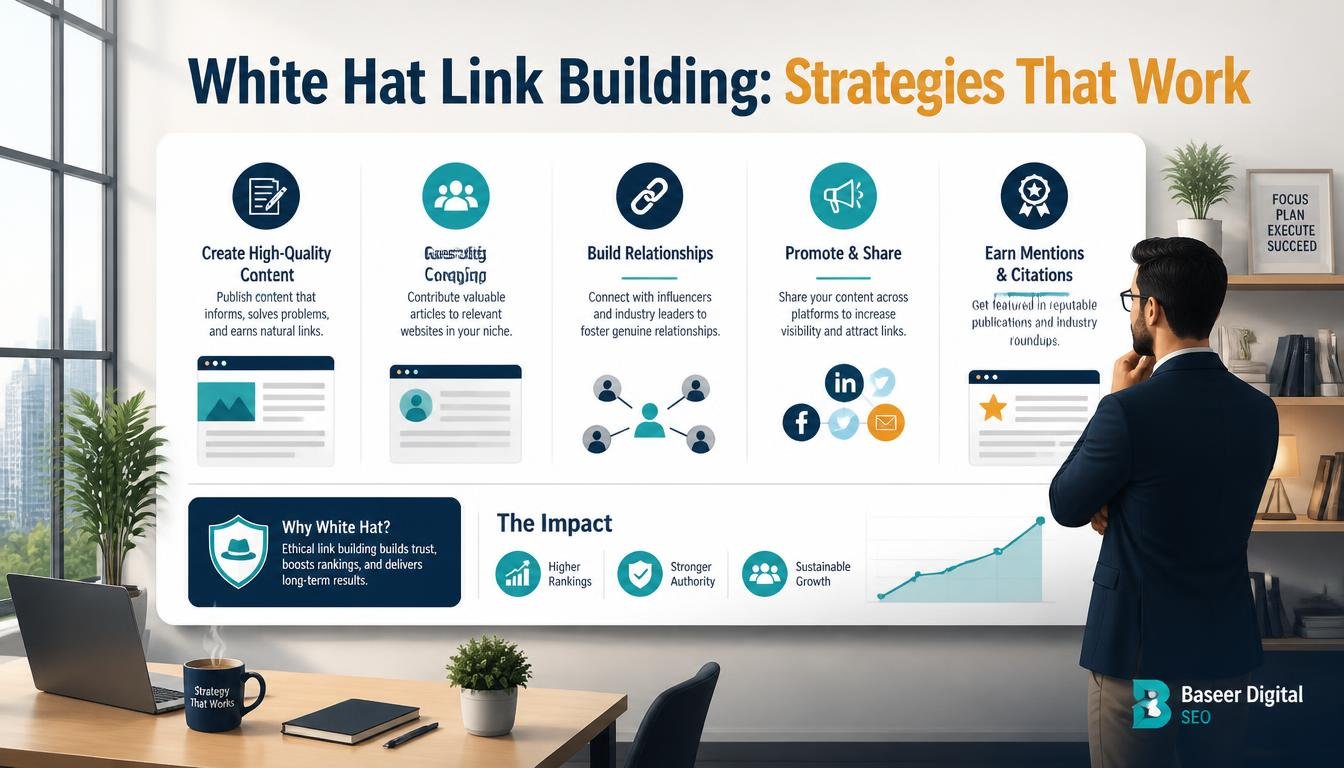
Most website owners learn about backlinks the same way: a competitor outranks them, and a quick look at the competitor’s profile shows links from publications the owner has never been able to reach. The temptation is to find a shortcut. Resist it. The approach that holds up over time is white hat link building, which means earning links through work that deserves them.
This guide explains how ethical link building works, which tactics are worth your time, and how to judge whether your efforts are paying off. It’s written for site owners, in-house marketers, and agencies in the US, UK, and Canada who want a repeatable process rather than a bag of tricks.
What Is White Hat Link Building?
White hat link building is the practice of earning backlinks through methods that align with search engine guidelines and give readers a genuine reason to link to you. A backlink is a link from another website to yours. The ethical version focuses on creating something worth citing, then making sure the right people know it exists.
How White Hat Link Building Works
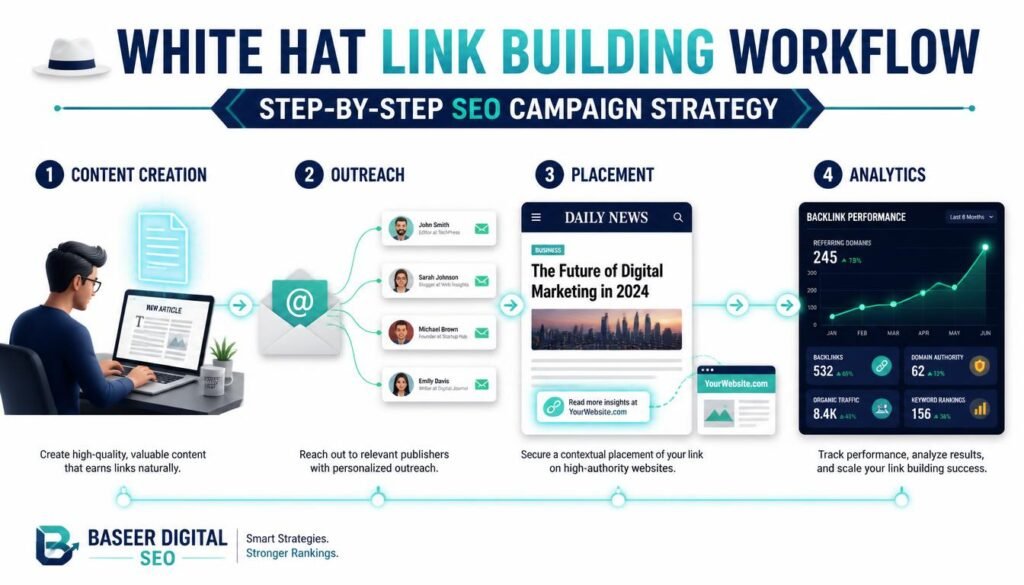
The process is simpler than it sounds. You publish something useful, such as original research, a detailed guide, a free tool, or a clear explanation of a hard topic. Then you put it in front of people who write about that subject: journalists, bloggers, editors, and resource-page curators. If it helps their audience, some of them link to it.
Nothing about this is automatic. A strong asset with no promotion earns few links, and a weak asset with heavy promotion earns even fewer. Real white hat SEO sits in the middle: quality content paired with deliberate, respectful outreach.
The Role of Editorially Earned Backlinks
An editorially earned backlink is one a site publishes because it chose to, not because it was paid or pressured. Think of a UK trade publication citing a retailer’s original supplier survey, or a Canadian accounting firm’s tax checklist appearing in a regional business magazine. The link exists because the content helped the writer’s readers.
Google’s spam policies target links created to manipulate rankings, such as paid placements that pass PageRank and large-scale exchanges. Editorial links are the opposite: the signal of endorsement is real.
Why White Hat Link Building Matters for SEO
Links remain one of the ways search engines discover pages and understand how the web connects. That’s the reason SEO link building still deserves a place in your strategy, even though content quality and relevance matter just as much.
How Quality Backlinks Support Search Visibility
Search engines follow links to find new pages, and links from relevant sources help them understand what your content is about and whether others find it trustworthy. Quality backlinks from sites in your field also send referral visitors, some of whom become customers or subscribers.
Not every link helps, though. A link from an irrelevant or spammy site may do nothing, and a pattern of manipulative links can cause problems. Quantity alone is a poor goal.
The Relationship Between Backlinks, Authority, and Organic Traffic
A site that’s regularly cited by credible sources tends to build visibility over time, which supports organic traffic growth. But the relationship is indirect. Links help pages get found and trusted, and strong content then earns clicks and engagement. No one can promise that a certain number of links produces a certain ranking, and you should be wary of anyone who does.
White Hat vs. Black Hat Link Building
The two approaches differ less in technique than in intent. One tries to earn attention; the other tries to fake it.
Key Differences Between Ethical and Manipulative Link Building
Ethical link building rewards usefulness. Black hat link building tries to manufacture signals of popularity. Here’s how they compare:
| Factor | White hat | Black hat |
|---|---|---|
| Source of links | Editorial choice by the publisher | Purchased, automated, or exchanged at scale |
| Focus | Relevance and reader value | Volume and fast results |
| Anchor text | Natural and varied | Keyword-stuffed and repetitive |
| Risk profile | Low; builds slowly | High; can be neutralized or penalized |
| Sustainability | Compounds over time | Often collapses after algorithm updates |
Why Link Farms and Private Blog Networks Can Be Risky
Link farms are groups of low-quality sites created to link to each other. Private blog networks (PBNs) are similar, built from expired or purpose-made domains whose only job is to pass links to a “money site.” Google’s spam policies treat link schemes meant to manipulate rankings as violations, and the company’s systems are designed to ignore or neutralize many spammy links. In more serious cases, a site can face a manual action.
Beyond the policy risk, there’s a practical one: these links tend to be fragile. When a network gets deindexed, the links vanish, and you’ve spent money for nothing.
Best White Hat Link Building Strategies That Work
Good link building strategies share a pattern. They start with value, target relevant audiences, and treat every link as a byproduct of a useful interaction.
Create Link-Worthy Content and Useful Resources
Writers link to things that save them time or support a claim. Original surveys, data roundups, calculators, templates, glossaries, and well-sourced guides all fit. A US SaaS company might publish an annual benchmark report on how teams use its category of software, giving industry journalists something fresh to cite.
Ask one question before creating anything: Who would reference this, and why? If you can’t answer it, the asset probably won’t earn links.
Build Relationships Through Link Building Outreach
Link building outreach works best when it’s really relationship-building. Follow writers, read their work, and share their articles before you ever ask for anything. A UK e-commerce brand selling outdoor gear, for example, could get to know walking and camping bloggers by offering product samples for honest review and expert tips for their guides.
Keep your pitches short, specific, and clearly relevant to the person’s recent work.
Use Digital PR to Earn Editorial Backlinks
Digital PR creates newsworthy stories, such as data studies, expert commentary, and timely reactions to industry events, that journalists want to cover. A Canadian professional services firm might analyze publicly available employment or housing data and offer a regional angle to local business reporters. The goal is coverage, and links follow when the story is strong.
Respond quickly to journalist requests when you have real expertise. Credibility builds with every accurate, helpful quote.
Find Relevant Guest Posting Opportunities
Guest posting remains useful when it’s about contributing knowledge to an audience that fits yours. Look for sites that publish original, editorially reviewed work and that readers in your industry actually visit. Avoid placements where the post exists mainly to carry a keyword-rich link.
Reclaim Unlinked Brand Mentions and Broken Links
Two quick wins are often overlooked. First, search for places that mention your brand, product, or people without linking, and politely ask for a link. Second, find broken links on relevant sites that pointed to content similar to yours, then suggest your page as a replacement. Both approaches help the site owner while earning you a link.

How to Earn High-Quality Backlinks Naturally
Natural link earning is mostly about being findable, useful, and relevant to the right audience. It’s slower than buying links, but the results hold up.
How to Identify Relevant, Trusted Websites
Start with sites your target customers already read. Industry publications, professional associations, university departments, local business groups, and respected niche blogs are all candidates. Check that the site publishes real content, has an engaged audience, and doesn’t sell links openly.
Many high-authority websites are worth pursuing, but “authority” here means credibility in your field, not just a score. A small specialist publication can be a better link source than a famous but unrelated one.
Why Contextual Relevance Matters More Than Metrics Alone
A link placed inside a paragraph that genuinely discusses your topic carries more meaning than one dropped into a footer or sidebar. Ask yourself whether a reader of that page would find your link useful. If the answer is yes, it’s probably a good link regardless of the site’s numbers.
Guest Posting and Blogger Outreach for Link Building
Guest posting and outreach overlap, but each needs its own plan.
How to Plan an Effective Guest Posting Campaign
Define your goal first: brand exposure, referral traffic, or credibility with a specific audience. Then build a target list, study each site’s editorial standards, and pitch topics that fill a real gap. Keep volume modest, because a handful of excellent contributions beats dozens of forgettable ones.
Google’s guidance warns against large-scale guest posting campaigns that stuff keyword-rich anchor text into articles. Use a plain brand or descriptive anchor, and let the content do the work. If a link is part of a paid or sponsored arrangement, it should be marked with rel=”sponsored” or rel=”nofollow”.
How to Write Personalized Blogger Outreach Emails
Good blogger outreach emails are brief and specific. Mention a recent post, explain what you’re offering, and make it easy to say yes or no. Here’s a simple structure:
- A genuine, specific opening about their work
- One sentence on what you have to offer
- Why it fits their readers
- A polite close with no pressure
Avoid templates that could be sent to anyone. Editors can spot them immediately, and personalization is usually the difference between a reply and silence.
How to Choose Relevant Websites for Guest Contributions
Look for editorial standards, a real readership, and topical overlap with your expertise. Warning signs include “write for us” pages that advertise guaranteed links, sites covering wildly unrelated topics, and obvious paid-post patterns.
How to Evaluate Backlink Quality and Relevance
Not all links deserve the same attention. Evaluating them helps you prioritize outreach and spot problems early.
Assess Website Relevance and Organic Traffic
Ask whether the linking site covers topics related to yours and whether it earns real visitors. A site with a steady audience and consistent publishing is a better sign than one with a high score but little actual readership. Tools can estimate traffic, but treat those estimates as directional, not exact.
Understand Domain Authority and Other SEO Metrics
Domain authority is a Moz metric. Other tools have their own versions, such as Domain Rating or Authority Score. These are third-party estimates, useful for comparing sites and spotting patterns, but they aren’t Google ranking factors and Google doesn’t use them. Use them as a rough filter, never as the final judgment.
Build a Natural and Relevant Anchor Text Profile
Anchor text is the clickable text of a link. Natural profiles include a mix of brand names, page titles, bare URLs, and descriptive phrases. If most of your anchors repeat the same commercial phrase, that pattern can look manipulative. You can’t fully control what others write, so don’t over-engineer it.
Internal link building deserves a quick note here, because the two are often confused. External backlinks come from other websites, while internal links connect pages within your own site. Internal links help visitors navigate and help search engines discover and understand your content, but they aren’t a substitute for earned backlinks. Both belong in a healthy strategy.
Common Link Building Mistakes to Avoid
Most problems come from impatience. Knowing the usual traps helps you avoid them.
Avoid Buying Manipulative Links and Using Link Schemes
Paying for links that pass ranking value, joining link exchanges at scale, or using automated link generation all violate Google’s spam policies. Some white hat link building services offer legitimate work, such as research, content creation, and outreach, but any provider guaranteeing a specific number of links by a deadline should raise questions. Ask how links are earned, request examples of past placements, and walk away if the answers are vague.
Avoid Low-Quality, Irrelevant Backlink Placements
A link from an unrelated directory, a comment spam post, or a thin article on a site that publishes anything for a fee does little for you. Worse, it can dilute an otherwise clean profile. Fewer, better links are almost always the smarter investment in backlink building.
How to Measure Link Building Results
A link-building campaign needs clear goals, otherwise you’ll never know what worked. Review results over months, not days.
Track Referring Domains and Backlink Growth
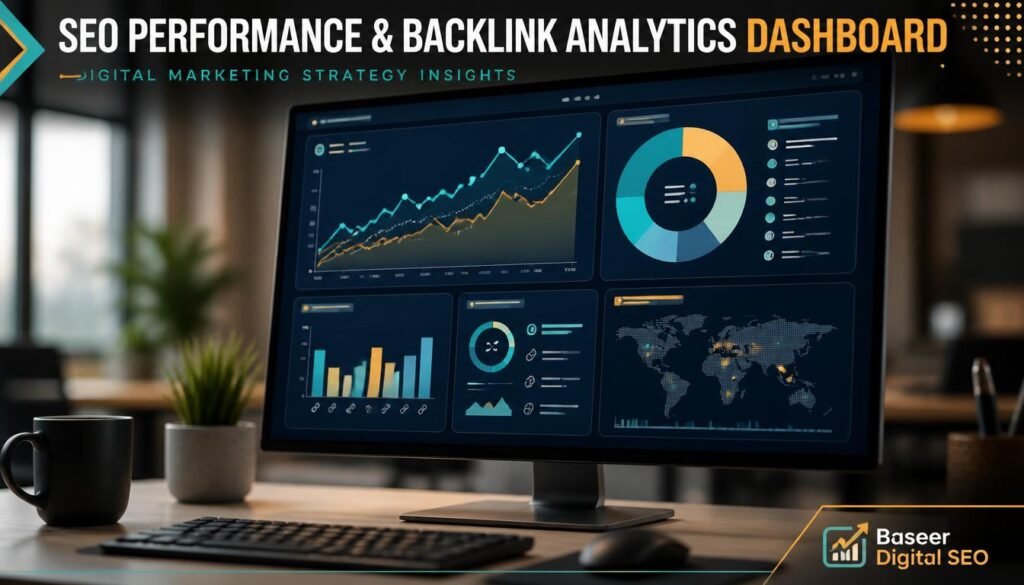
Referring domains, the number of unique sites linking to you, give a clearer picture than raw backlink counts, since one site can generate many links. Watch the trend, and pay attention to relevance and diversity, not just growth.
Measure Organic Traffic and Relevant Keyword Performance
Use Google Search Console and your analytics platform to track organic traffic growth, impressions, and rankings for pages you’ve promoted. Look for improvements in search engine rankings for the topics your content targets. Remember that other factors, such as content updates, seasonality, and algorithm changes, also influence results, so avoid crediting links alone.
Evaluate the Long-Term Value of Link Building Campaigns
Some of the best results are hard to count: brand mentions, referral visits from trusted sites, and new relationships with editors. A marketing agency managing a white hat link-building campaign for clients should report on these alongside the usual numbers and explain what the work is building toward.
Frequently Asked Questions
What Is the Safest Way to Build Backlinks?
Create genuinely useful content and promote it to relevant people who’d benefit from it. Digital PR, relationship-based outreach, and unlinked mention reclamation are among the lowest-risk approaches because the links are earned by merit.
How Long Does White Hat Link Building Take?
There’s no fixed timeline. Some placements arrive within weeks, while others take months of relationship-building. Search engines also need time to recrawl and reassess pages. Plan for a sustained effort of several months before judging results.
Is Guest Posting a White Hat Link Building Strategy?
It can be, when the goal is sharing real expertise with a relevant audience. It becomes a problem when it’s done at scale mainly to place keyword-rich links, or when payment for links isn’t disclosed with the appropriate link attributes.
How Many Backlinks Does a Website Need?
There’s no magic number. The right amount depends on your industry, competition, and the pages you want to rank. Instead of chasing a count, compare your link profile with the competitors ranking for your target topics and focus on closing gaps in quality and relevance.
Can White Hat Link Building Improve Google Rankings?
It can contribute, especially for competitive topics where strong content already exists. But rankings depend on many factors, including content quality, relevance, user experience, and technical health. No ethical practitioner can guarantee a particular ranking.
Conclusion: Build Links Worth Earning
White hat link building rewards patience and craft. The core lessons are straightforward: create assets people want to cite, reach out with respect, favor relevance over raw metrics, and measure progress honestly. Avoid link farms, PBNs, and paid schemes, because the short-term gain rarely outlasts the risk.
If you’re ready to start, here are four practical next steps:
- Audit your best existing content and identify two or three pieces worth promoting.
- Build a list of 20 relevant sites and writers in your field, and engage with their work first.
- Set up tracking in Google Search Console and a backlink tool so you have a baseline.
- Strengthen internal link building across your own site so new link equity and visitors flow to the pages that matter.
Treat link building as part of a broader white hat SEO program, and the results tend to compound.





Leave a Reply