
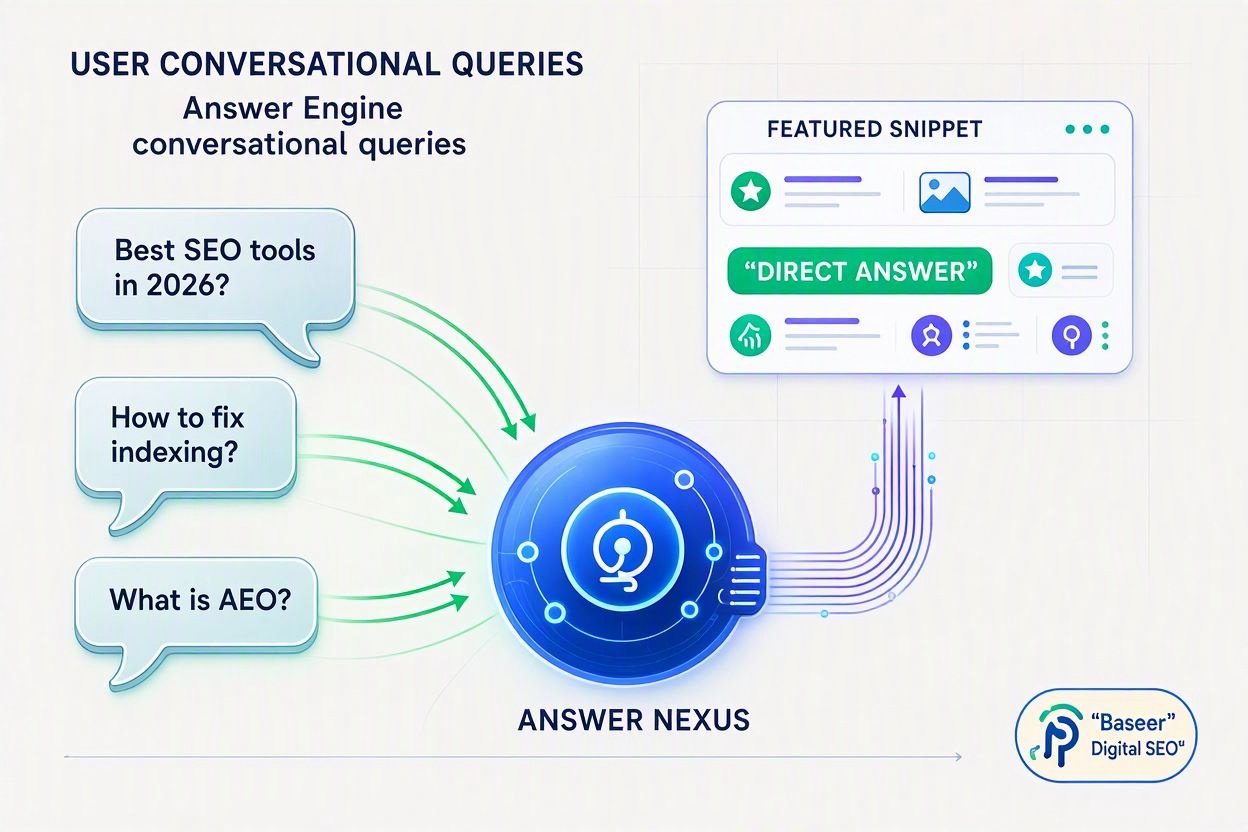
Search behavior is changing rapidly. Instead of typing short keywords into a search box, people increasingly ask complete questions through AI-powered search experiences and conversational assistants.
This shift has created a new opportunity for businesses, publishers, and SEO professionals: Answer Engine Optimization (AEO).
AEO focuses on creating content that can be easily understood, extracted, summarized, and cited by answer engines. It does not replace traditional SEO. Instead, it builds on strong SEO fundamentals while adapting content for conversational search.
In this guide, you’ll learn how to optimize for AI search and AEO, how conversational queries work, how to structure content for direct answers, and how to measure your visibility across modern AI search platforms.
What Is Answer Engine Optimization (AEO)?
Answer Engine Optimization is the practice of structuring and improving content so that AI-powered answer engines can understand the information and potentially use it when generating answers.
Traditional SEO primarily focuses on visibility in search results. AEO adds another layer: making information easy for AI systems to identify, understand, summarize, and attribute.
Platforms such as ChatGPT, Perplexity, and Google’s AI search experiences can provide answers directly to users. This means a website may receive visibility through an AI-generated answer even when the user does not interact with a traditional search result in the usual way.
AEO vs. Traditional SEO
| Traditional SEO | Answer Engine Optimization |
|---|---|
| Focuses heavily on search rankings | Focuses on being useful for generated answers |
| Targets keywords and search queries | Targets questions and conversational intent |
| Optimizes search-result pages | Optimizes content for extraction and understanding |
| Often emphasizes clicks | Can also emphasize citations and brand visibility |
| Uses technical SEO and content optimization | Builds on technical SEO and adds answer-focused structure |
The two approaches work together. Strong technical SEO, crawlability, useful content, clear structure, and authoritative information remain important foundations.
Image Caption: How Answer Engine Optimization Changes the Search Experience

Why AEO Has Become Important in 2026
Search is becoming more conversational. Users can ask detailed questions instead of constructing several keyword searches, and AI-powered search experiences can summarize information from multiple sources.
For businesses, this creates another visibility layer to consider.
AEO can be particularly relevant for:
- SaaS companies
- E-commerce brands
- SEO agencies
- Publishers
- Financial and business websites
- Technology companies
- Professional service businesses
- Educational websites
- B2B companies
The objective is not simply to appear everywhere. The goal is to publish genuinely useful information that can serve as a reliable answer to specific questions.
Understanding Zero-Click Searches
A zero-click search occurs when a user receives enough information directly within the search experience that they do not need to visit another website.
Featured snippets were an early example of this behavior. AI-generated answers have expanded the concept by summarizing information conversationally.
This makes brand visibility, citations, and source attribution important considerations alongside traditional organic traffic.
How AI Answer Engines Discover and Use Content
Different AI search systems may use different retrieval and ranking processes. Therefore, there is no single optimization trick that guarantees visibility across every platform.
ChatGPT Search
ChatGPT can provide answers using web search and may cite websites as sources. For publishers, technical accessibility and allowing relevant search crawlers to access content are important foundations.
However, being technically accessible does not guarantee that a page will appear in a particular answer.
Perplexity
Perplexity is designed around research-style answers and commonly provides source citations alongside generated responses.
This means useful, well-supported content can have value beyond traditional keyword rankings.
Google AI Overviews and AI Mode
Google’s AI search experiences build on Google’s broader search infrastructure while presenting information in a more conversational format.
Traditional SEO therefore remains relevant. Helpful content, clear page structure, strong technical foundations, and understandable information continue to matter.
The Four Types of Answer Engine Search Intent
Effective AEO begins with understanding what the user actually wants to accomplish.
1. Definitional Intent
Example:
What is Answer Engine Optimization?
The page should provide a concise definition near the beginning before expanding into additional details.
2. Process Intent
Example:
How do I optimize content for AI search?
Use numbered instructions and practical steps.
3. Comparison Intent
Examples:
- AEO vs. SEO
- ChatGPT vs. Perplexity
- Traditional search vs. AI search
Use tables, clear distinctions, and balanced explanations.
4. Decision Intent
Examples:
- How should a business approach AEO?
- What should I consider when choosing an AEO tool?
Explain evaluation criteria rather than simply presenting unsupported claims.
How to Optimize for AI Search and AEO
Once the search intent is clear, you can structure content to make it easier for both humans and search systems to understand.
Step 1: Answer the Question Quickly
When a section targets a specific question, provide the direct answer near the beginning.
Avoid forcing readers through several paragraphs before revealing the main point.
A useful structure is:
- Direct answer
- Explanation
- Evidence or examples
- Additional context
- Related questions
This approach improves readability and makes the page easier to understand.
Step 2: Build Strong E-E-A-T Signals
Demonstrate experience, expertise, authority, and trustworthiness throughout your content.
Useful practices include:
- Identifying the author
- Showing relevant expertise
- Citing credible sources
- Supporting important claims
- Keeping information updated
- Providing original insights
- Avoiding exaggerated claims
The objective is to make the content useful and trustworthy rather than simply optimized for algorithms.
Step 3: Use Clear Headings and Content Structure
Use a logical hierarchy:
- H1 for the primary topic
- H2 for major sections
- H3 for supporting topics
Break complex information into manageable sections.
For example:
H2: How to Optimize for AI Search
Then:
H3: Answer Questions Directly
H3: Improve Content Structure
H3: Strengthen Authority Signals
This makes the page easier for both readers and search systems to navigate.
Step 4: Use Natural Conversational Language
People often phrase AI-search queries as complete questions.
Instead of targeting only:
AEO strategy
also consider natural questions such as:
- What is AEO?
- How does AEO work?
- How can I optimize my website for AI search?
- How can businesses improve visibility in AI-generated answers?
- What is the difference between AEO and SEO?
Do not force these phrases unnaturally. Write for the user’s actual information need.
Step 5: Create Question-Based Topic Clusters
One article rarely answers every possible question about a subject.
Build supporting content around your main topic.
For an AEO website, a cluster could include:
- What is AEO?
- AEO vs. SEO
- How does AI search work?
- How to optimize content for AI search
- How to improve featured snippet visibility
- How to structure FAQ content
- How to measure AI search visibility
Then connect related articles with internal links.
Step 6: Create Comprehensive Topic Coverage
AEO is not simply about writing short answers.
A strong page should provide enough context to satisfy the user’s broader intent.
Cover:
- Definitions
- Examples
- Processes
- Comparisons
- Advantages and limitations
- Common mistakes
- Practical recommendations
- Frequently asked questions
The goal is useful completeness, not unnecessary length.
Step 7: Optimize for Direct Answers and Featured Snippets
Featured snippets and AI-generated answers often reward content that is clearly structured.
Consider using:
- Short definitions
- Numbered steps
- Bullet lists
- Comparison tables
- Concise explanations
- Question-based headings
However, featured snippet visibility should not be treated as a guaranteed pathway to AI citations. The underlying principle is simply to make important information easy to understand and extract.
Step 8: Strengthen Entity Relationships
AI systems need context.
If your article discusses AEO, clearly explain its relationship with concepts such as:
- Search engine optimization
- Conversational search
- Generative AI
- Search intent
- Structured data
- Featured snippets
- AI Overviews
- AI Mode
- Search citations
Use precise terminology rather than vague references.
Step 9: Use Structured Data Where Appropriate
Structured data can help search engines understand the content and entities on a page.
Depending on the content, relevant markup may include:
- Article
- Organization
- Breadcrumb
- Product
- FAQ where appropriate
Structured data should accurately represent the visible content on the page. It should not be used to manipulate search systems.
Step 10: Maintain Technical SEO Fundamentals
AEO does not eliminate technical SEO.
Make sure important pages are:
- Crawlable
- Indexable
- Mobile-friendly
- Fast enough for users
- Internally linked
- Canonically configured
- Free from unnecessary technical barriers
Also review robots.txt and other crawler controls carefully so that important content is not unintentionally inaccessible.
AI Search Engine Optimization vs. Traditional SEO
The strongest strategy is usually a unified one.
Traditional SEO provides the technical and content foundation. AEO adds an additional focus on conversational questions, direct answers, entities, citations, and AI search visibility.
A Unified AEO and SEO Checklist
- Maintain strong technical SEO fundamentals.
- Understand the searcher’s primary intent.
- Answer important questions directly.
- Use descriptive headings.
- Build topical depth and related content.
- Strengthen authorship and trust signals.
- Use appropriate structured data.
- Keep content accurate and updated.
- Make important information easy to find.
- Monitor both traditional search performance and AI visibility.
How to Rank in ChatGPT and Perplexity Search
There is no guaranteed formula for appearing in ChatGPT, Perplexity, or other AI-generated answers.
Instead, focus on making your content useful, accessible, authoritative, and relevant to the questions your audience actually asks.
Make Your Content Easy to Cite
A citation-friendly page should have:
- Clear claims
- Supporting evidence
- Relevant sources
- Descriptive headings
- Direct answers
- Specific examples
- Updated information
- Clear authorship
Avoid filling articles with vague statements that cannot be supported.
Measuring AEO Performance
AEO measurement can be more complicated than traditional SEO because an AI-generated answer may mention a brand without generating a direct website visit.
Track multiple signals.
1. Search Console Data
Monitor organic search performance and relevant search features available in your reporting.
2. Manual AI Search Testing
Test important customer questions across relevant platforms.
Record:
- Whether your brand appears
- Whether your website is cited
- Which page is cited
- What information is mentioned
- Which competitors or alternative sources appear
Run these tests periodically because AI-generated results can change.
3. Referral Traffic
Check analytics for visits coming from AI and conversational platforms.
This can help identify whether AI visibility is generating measurable website traffic.
4. Branded Search Demand
Track branded searches over time as one additional signal of growing awareness.
It should not be treated as a standalone measurement of AEO success, but it can provide useful supporting evidence.
Image Caption: Measuring Visibility Across AI Search and Conversational Platforms

A Practical AEO Strategy for Businesses in 2026
Businesses can begin with a relatively simple workflow.
Step 1: Identify Important Customer Questions
Review:
- Search queries
- Customer emails
- Sales calls
- Support questions
- FAQ requests
- Social discussions
- Existing website analytics
Find questions that indicate genuine customer needs.
Step 2: Group Questions by Intent
Separate questions into:
- Definition
- How-to
- Comparison
- Problem-solving
- Buying/decision intent
Create appropriate content structures for each group.
Step 3: Improve Existing Content
You do not always need to publish new articles.
Review your existing pages and identify:
- Missing direct answers
- Weak introductions
- Outdated information
- Unsupported claims
- Poor headings
- Missing examples
- Weak internal links
Then improve the pages that already have useful authority or traffic.
Step 4: Build Topic Authority
Create supporting articles around important subjects.
For example, an SEO agency could create a content cluster around:
AEO
→ What Is AEO?
→ AEO vs. SEO
→ How AI Search Works
→ Conversational Keyword Research
→ AI Search Content Strategy
→ Measuring AI Search Visibility
This gives users multiple useful resources while strengthening the overall topical structure of the website.
Step 5: Monitor and Update
AI search changes quickly.
Review important content regularly and update:
- Statistics
- Platform information
- Examples
- Product features
- Search terminology
- Sources
- Screenshots where necessary
AEO should be treated as an ongoing content and SEO process rather than a one-time optimization task.
Common AEO Mistakes to Avoid
Keyword Stuffing
Adding the same conversational keyword repeatedly can make content unnatural.
Writing Only for AI
Your primary audience is still the human reader.
If the article is difficult or unpleasant to read, technical optimization will not solve the problem.
Making Unsupported Claims
Avoid statements such as:
- “This guarantees ChatGPT rankings.”
- “This trick always gets AI citations.”
- “This method guarantees Google AI Overview visibility.”
AI search results can change, and no single technique guarantees inclusion.
Ignoring Traditional SEO
AEO is not a replacement for:
- Technical SEO
- Crawlability
- Helpful content
- Internal linking
- Search intent
- Page experience
- Authority building
Publishing Generic AI Content
Using AI to produce large amounts of generic content without adding useful expertise, evidence, examples, or original information can weaken content quality.
Use AI as a productivity tool, not as a substitute for expertise.
AEO Checklist for 2026
Before publishing an AEO-focused article, check the following:
- Does the introduction clearly explain the topic?
- Is the main question answered quickly?
- Is the content organized with logical H2 and H3 headings?
- Does each section satisfy a clear search intent?
- Are conversational questions included naturally?
- Are important claims supported?
- Is author information clear?
- Are relevant entities explained?
- Is structured data implemented accurately where appropriate?
- Can search crawlers access the page?
- Are internal links relevant?
- Is the content useful to humans first?
- Has outdated information been removed?
- Are important AI-search queries being monitored?
Final Thoughts
Answer Engine Optimization is becoming an important extension of modern SEO. As search becomes more conversational, businesses need content that does more than target keywords.
The strongest approach is to create useful, well-structured, trustworthy content that directly answers real questions.
Focus on:
- Search intent
- Direct answers
- Conversational queries
- Topical depth
- Clear structure
- Strong technical SEO
- Trustworthy sources
- Accurate information
- Appropriate structured data
- Continuous measurement
Rather than trying to find an AEO shortcut, build content that deserves to be cited.
Ready to strengthen your AEO strategy? Start by identifying your ten most important customer questions. Test those questions across relevant AI search platforms, analyze what information is being surfaced, and improve your existing content around the gaps you discover.
SEO Keywords
Primary Keywords:
- answer engine optimization strategy 2026
- how to optimize for AI search and AEO
- ranking for conversational queries SEO
Secondary Keywords:
- AI search engine optimization
- AEO SEO strategy
- conversational search optimization
- AI search optimization
- answer engine optimization
Long-Tail Keywords:
- how to rank in ChatGPT and Perplexity search
- AI search engine optimization vs traditional SEO
- how to optimize content for AI search
- how to improve visibility in AI-generated answers
- AEO strategy for businesses in 2026





Leave a Reply