
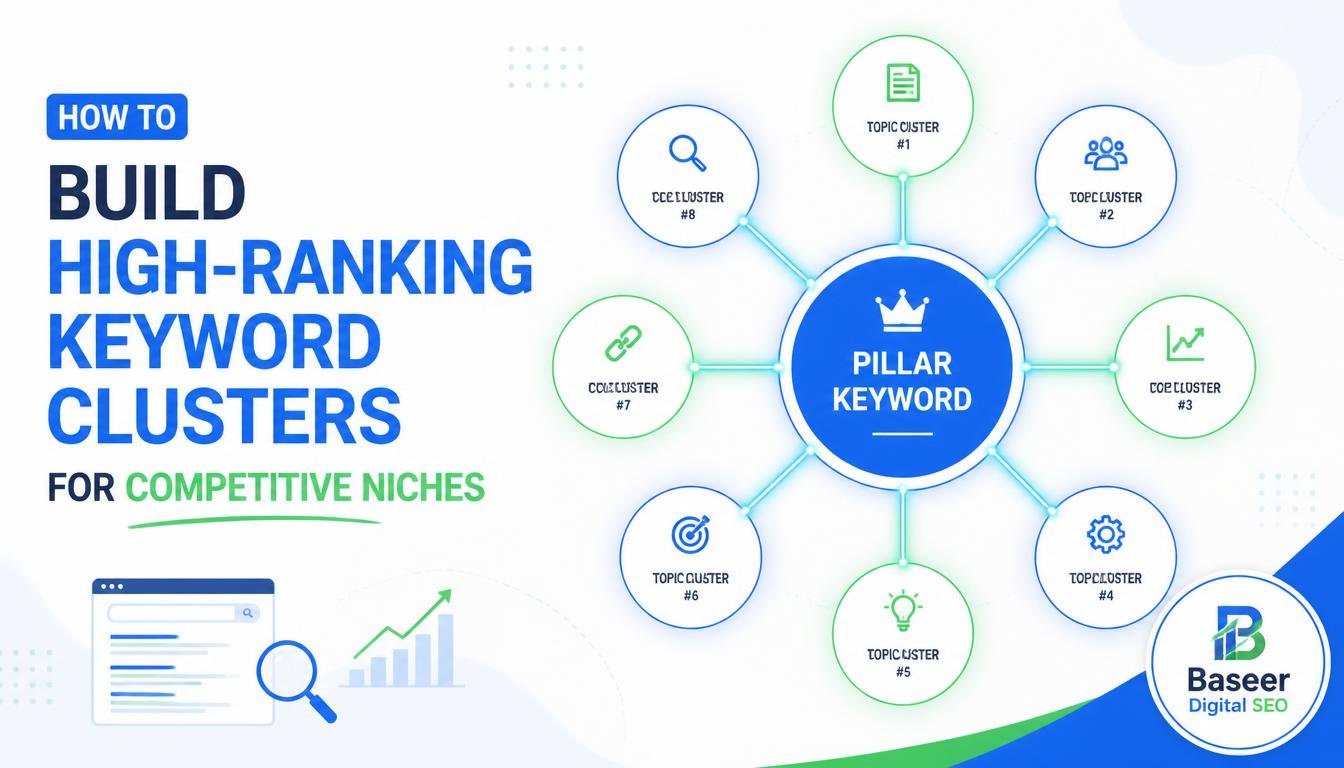
Competing with established websites can be frustrating. They already have years of content, strong backlink profiles, and the resources to publish consistently. Trying to outrank them by targeting the same broad keywords often leads to slow progress and disappointing results.
A better approach is to look beyond individual keywords and organize your content around closely related topics and search intent.
Learning how to build keyword clusters helps you identify realistic opportunities, create more useful content, and connect related pages into a clear website structure. Instead of publishing separate articles for every keyword variation, you can focus on answering a group of related questions with the right combination of pages.
For example, a US-based software company might struggle to rank for a broad term such as “project management software.” However, it could find more specific opportunities around project management for creative agencies, client approval workflows, or project tracking for small teams.
The same approach works for UK e-commerce businesses and Canadian professional service providers. The key is understanding what people are searching for, what the current results offer, and where your website can provide something better.
This guide explains how to research, organize, map, and measure keyword clusters for competitive niches.
What Are Keyword Clusters in SEO?
A keyword cluster is a group of closely related search terms that can be targeted through one page or a connected group of pages. The right grouping depends on the topic, the searcher’s intent, and the type of content that best answers the query.
Keyword clustering for SEO helps you decide which keywords belong together and which deserve separate pages.
Consider a UK online retailer selling garden furniture. These searches have closely related commercial intent:
- Rattan garden sofa
- Rattan corner sofa set
- Best rattan garden furniture
Depending on the search results and the retailer’s website structure, these terms might be targeted on one category page or across closely related pages.
Now consider “how to clean rattan furniture.” Although it mentions the same product, it has a different purpose. The searcher wants cleaning advice rather than a product category. A separate guide would probably be more appropriate.
This distinction is important. Keyword clustering is not simply about finding words that look similar. It’s about identifying searches that can be satisfied by the same content.

Why Keyword Clustering Matters for Competitive Niches
In competitive markets, publishing more content doesn’t automatically produce better rankings. A website can have hundreds of articles and still struggle if those pages target overlapping queries or fail to answer searchers’ questions.
A well-planned SEO keyword clustering strategy gives your content a clearer purpose.
Clustering also supports visibility beyond classic rankings. If you want to see how this fits into the bigger picture, our guide on AI search optimization explains how topic depth helps your content get understood and referenced by AI-powered search.
Build topical depth
A strong topical authority SEO strategy involves creating useful, relevant content across the important aspects of a subject. A single article may answer one question, while supporting pages explore specific problems, comparisons, and practical solutions.
For example, a Canadian accounting software company could publish a comprehensive guide to bookkeeping for small businesses, supported by articles about expense tracking, invoicing, cash flow, and tax record organization.
Together, these pages provide readers with a more complete resource.
Find opportunities beyond broad keywords
Broad search terms often attract established publishers and major brands. More specific searches can reveal questions that are less thoroughly answered.
That doesn’t mean every long-tail keyword is easy to rank for. It means you have more ways to evaluate the competition and identify relevant gaps.
Improve internal linking
Related pages can direct readers to useful next steps. Someone reading about invoice management might also benefit from a guide to expense tracking or cash flow forecasting.
These connections improve navigation and help search engines discover relationships between pages.
Reduce unnecessary content production
Without a clustering plan, teams may publish several articles that answer essentially the same question. A cluster makes it easier to decide whether a new keyword belongs on an existing page or needs its own URL.
How to Build Keyword Clusters Step by Step
The process of how to create keyword clusters doesn’t require an enormous budget. You can begin with a spreadsheet and a keyword research tool, then add automation as your content strategy grows.
Step 1: Define your main topics
Start with the subjects most relevant to your business, services, or products.
A US-based customer relationship management (CRM) software company might begin with:
- CRM software for small businesses
- Sales pipeline management
- Customer onboarding
- Sales reporting
- CRM integrations
These are starting points, not finished clusters. Each topic needs further research to identify related searches and content opportunities.
Step 2: Collect relevant keywords
Use keyword research tools, Google Search Console, search suggestions, and customer questions to build a list.
Platforms such as Ahrefs, Semrush, and Google Keyword Planner can help you discover keyword ideas and evaluate search demand. Google Search Console is particularly useful for finding queries that already generate impressions for your website.
Organize the initial list without trying to group everything immediately. First, collect enough information to understand the subject and its potential subtopics.
Step 3: Evaluate search intent
Look at the current search results for your most promising terms. Determine whether users want information, product comparisons, a specific service, or a particular website.
Two phrases may look different but deserve one page if their intent and search results overlap substantially. Conversely, similar phrases may require separate pages if the results satisfy different needs.
Step 4: Evaluate competition and opportunity
Use keyword difficulty scores as an initial filter, not a final decision.
Review the pages currently ranking, their relevance, the quality of their answers, and whether your site can realistically compete. Consider your existing content, expertise, and ability to provide a better resource.
Step 5: Group related searches
Combine terms that share a clear subject and similar intent. Keep searches with substantially different purposes in separate groups.
This is the stage where your list starts becoming a content plan rather than a collection of disconnected phrases.
Step 6: Assign keywords to pages
Choose a primary keyword for each planned page, along with closely related secondary keywords. Decide whether the cluster belongs on an existing page or requires new content.
Step 7: Publish, link, and improve
Create useful content, link related pages where appropriate, and monitor performance. Review your clusters periodically as search results, customer needs, and your website change.
How to Find Low-Competition Keywords in Competitive Niches
Knowing how to find low competition keywords involves more than sorting a keyword tool by its lowest difficulty score.
A term with low estimated difficulty may have little commercial value. Another term with moderate difficulty might attract highly relevant visitors who are much more likely to become customers.
The objective is to find a balance between search demand, relevance, competition, and business value.
Explore long-tail keyword opportunities
Long-tail keyword clustering focuses on specific searches that often reveal a more clearly defined need.
For example, a US accounting software company might find it difficult to compete for “accounting software.” More specific topics could include accounting software for freelance designers, expense tracking for independent consultants, or invoicing tools for small creative agencies.
These searches may have lower volume, but their specificity can make them valuable to the right business.
Use keyword difficulty analysis carefully
Keyword difficulty analysis helps you estimate how challenging a query might be to rank for, depending on the tool’s methodology.
Before deciding to target a keyword, investigate:
- Ranking websites: Are the results dominated by major brands, or do relevant specialist sites also appear?
- Content quality: Do existing pages answer the question clearly and completely?
- Search intent: Can your planned page satisfy what searchers actually want?
- Website relevance: Does your site have relevant content and genuine expertise in the subject?
- Business value: Would attracting visitors through this query support your goals?
Effective keyword research for competitive niches combines tool metrics with manual analysis. Neither approach tells the complete story on its own.
How to Analyze Search Intent Before Grouping Keywords
Search intent is one of the most important factors in deciding whether keywords belong in the same cluster.
Search intent keyword clustering organizes queries according to what people are trying to accomplish, rather than relying only on similar wording.
Four common intent categories are:
- Informational: Someone wants to learn something, such as how to create a sales forecast.
- Commercial investigation: Someone is comparing options, such as the best CRM for a small business.
- Transactional: Someone is ready to take action, such as purchasing a particular software subscription.
- Navigational: Someone wants to reach a specific brand or website.
These categories can overlap, so treat them as useful guides rather than rigid rules.
For each important keyword, review the search results and ask whether the same type of page could satisfy the query.
If one search mainly returns detailed guides and another returns product comparison pages, combining them into one article might make it harder to meet both needs.
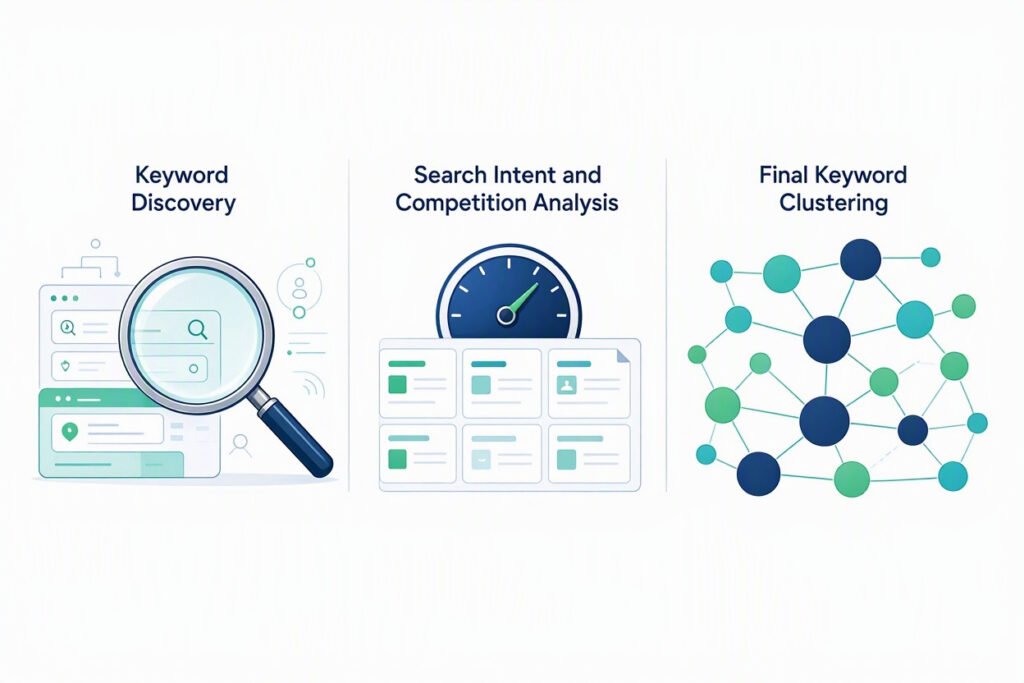
How to Perform Competitor Keyword Research
Competitor keyword research reveals the topics and search queries that competing websites are already targeting.
Start by identifying your search competitors. These are the websites competing for your target queries, which may differ from the businesses you compete with commercially.
For example, a Canadian law firm may compete in search results with legal directories, educational publishers, and government information pages, not just other law firms.
Follow this process:
- Identify websites that repeatedly appear for your target topics.
- Use a keyword research platform to investigate their ranking queries and relevant pages.
- Look for content gaps where competitors answer important questions poorly or incompletely.
- Examine pages from smaller, relevant competitors to discover potentially realistic opportunities.
- Review their headings, examples, page formats, and coverage of related questions.
- Compare their content with what your audience actually needs.
Don’t copy competitors’ articles or reproduce their structure without thinking. Use the research to identify missing explanations, outdated advice, unanswered questions, and opportunities to provide more practical information.
A useful content gap is not simply a topic another website has covered. It is a topic your audience needs that your own website can address meaningfully.
How to Group Keywords by Topic and Semantic Relevance
After collecting your keyword list, begin semantic keyword grouping. This means organizing searches around shared meaning, subject matter, and intent.
You can start manually in a spreadsheet or use a dedicated clustering tool to generate initial groups.
Some tools use search-result overlap to estimate which keywords may belong together. This can save time, but automated groups still require human review. Similar words do not always indicate identical intent.
Choose primary and secondary keywords
Understanding primary and secondary keywords helps keep each page focused without limiting its ability to address related searches.
- Primary keyword: The main query that best represents the page’s purpose.
- Secondary keywords: Closely related searches, variations, and questions that the same page can answer naturally.
You don’t need to repeat the primary keyword in every section. Clear headings, relevant explanations, and useful supporting details matter more than forcing exact-match phrases into the copy.
A practical example: A project management SaaS company
Imagine a US-based software company that provides project management tools for creative agencies.
Its keyword research might produce the following clusters:
| Cluster | Example keywords | Recommended page |
|---|---|---|
| Core topic | Project management for agencies; agency project workflows | Comprehensive pillar guide |
| Templates | Agency project plan template; client onboarding template | Dedicated resource pages where intent differs |
| Comparisons | Best project management software for agencies; agency software comparison | Software comparison page |
| Pricing | Project management software pricing for small teams | Pricing guide |
| How-to topics | How to track billable project hours; how to manage client approvals | Supporting articles |
The final page assignments should be confirmed by reviewing actual search results and the purpose of each page.
For example, two comparison phrases might belong on one page if searchers expect the same type of comparison. A downloadable onboarding template may need a separate resource page because it serves a different need.
How to Build Pillar Pages and Topic Clusters
Pillar pages and topic clusters create an organized structure for covering a subject in depth.
A pillar page provides a broad, useful overview of a main topic. Supporting pages explore specific subtopics in more detail. Internal links connect the pages so readers can move naturally between related resources.
For example, a UK e-commerce consultancy might create a pillar guide about improving online store performance. Supporting articles could cover product page optimization, checkout usability, site speed, and conversion tracking.
Topic clusters for SEO are most useful when every page has a distinct purpose and provides value on its own.
A practical content cluster strategy includes:
- One comprehensive pillar page covering the main subject.
- Supporting pages addressing distinct subtopics and questions.
- Contextual internal links between relevant pages.
- Clear navigation and descriptive link text.
- Regular updates when information becomes outdated.
There is no universal requirement to publish five or ten supporting pages. Start with the subtopics that matter most to your audience, then expand when research identifies additional opportunities.

How to Map Keywords to Existing and New Content
Keyword mapping for SEO means assigning each keyword cluster to the most appropriate page on your website.
A simple spreadsheet is often enough to get started. Include these columns:
- Cluster name
- Primary keyword
- Secondary keywords
- Search intent
- Target URL
- Existing or new content
- Priority
- Last reviewed date
Audit your current content before creating new pages. You may already have an article that partially addresses a cluster and could perform better after an update.
For example, a UK e-commerce store may already have a category page for women’s waterproof jackets. If that page matches the search intent, improving its product information, navigation, and useful buying guidance may be more appropriate than creating another page targeting the same searches.
Create a new URL when the topic and intent genuinely warrant a separate resource.
How to Prevent Keyword Cannibalization
Keyword cannibalization prevention starts with clear keyword mapping and distinct page purposes.
Cannibalization is often discussed when multiple URLs compete for the same queries. However, two pages appearing for related keywords is not automatically a problem. Search engines can rank multiple pages from one website when each provides a useful, distinct answer.
Investigate when you notice:
- Two pages repeatedly competing for the same important query.
- Similar articles with substantially overlapping content.
- Rankings shifting between URLs without a clear reason.
- Several pages targeting the same intent without distinct value.
Use Google Search Console to investigate queries and the URLs receiving impressions or clicks. Review the pages manually before making changes.
Possible solutions include merging genuinely overlapping articles, redirecting a retired URL to its replacement, improving the distinction between pages, or strengthening internal links to the most appropriate resource.
Don’t delete a page simply because it shares a few keywords with another page. Preserve useful content and make decisions based on search intent, page quality, and performance.
Best Tools for Keyword Research and Clustering
The right tool depends on your workflow, budget, and the complexity of your website.
- Google Search Console: Helps you discover queries, impressions, clicks, and ranking information for your own site.
- Google Keyword Planner: Provides keyword ideas and search-volume estimates for planning.
- Ahrefs: Offers keyword research, competitive analysis, and backlink-related research features.
- Semrush: Supports keyword discovery, competitor research, and broader SEO workflows.
- Moz: Provides SEO research tools, including keyword-related metrics.
- Keyword clustering tools: Can help group large keyword lists using semantic analysis or search-result overlap.
- Spreadsheets: Useful for reviewing intent, assigning URLs, prioritizing opportunities, and maintaining a content plan.
Features, pricing, and available data vary by product and subscription. Check the current product documentation before choosing a paid tool.
For a small site, a spreadsheet and Google Search Console may be enough to begin. Larger sites with thousands of keywords may benefit from automated grouping, followed by a manual quality review.
Common Keyword Clustering Mistakes to Avoid
Even a detailed keyword list can produce a poor content strategy if the grouping decisions are wrong.
Watch out for these mistakes:
- Grouping by wording alone: Similar phrases may have different search intent.
- Creating too many pages: Separate URLs for every minor variation can produce repetitive content.
- Ignoring existing content: An existing page may already be the best match for a keyword cluster.
- Chasing difficulty scores: A low score does not automatically mean the keyword is valuable or easy to rank for.
- Overlooking internal links: Related pages should connect naturally when those links help readers.
- Publishing thin supporting articles: Each page should answer a real question rather than exist merely to complete a cluster.
- Never revisiting your plan: Search demand, competing pages, and business priorities can change.
The objective is not to maximize the number of clusters. It is to build a content structure that matches real search needs.
How to Measure Keyword Cluster Performance
Once your pages are published, measure whether the cluster is attracting relevant search visibility and supporting business goals.
Google Search Console can help you evaluate impressions, clicks, click-through rates, average positions, and the queries associated with your pages.
Analytics tools can provide additional information about organic visits, engagement, and conversions, depending on your tracking setup.
Once your organic traffic starts to grow, learning how to monetize a website with AdSense can be a sensible next step.
Track performance at two levels.
At the page level:
- Is the page appearing for relevant queries?
- Are impressions and clicks increasing?
- Does the content satisfy the intended search purpose?
- Are visitors taking useful next steps?
At the cluster level:
- Are multiple relevant pages gaining visibility?
- Are supporting pages contributing to organic traffic?
- Are internal links helping visitors discover related resources?
- Are organic visitors generating enquiries, sign-ups, or sales?
Allow enough time to observe meaningful trends, particularly in competitive markets. If progress stalls, reassess the search intent, quality of the content, technical accessibility, competition, and internal linking before deciding what to change.

Final Tips for Ranking for Competitive Keywords
Learning how to rank for competitive keywords takes research, useful content, and ongoing improvement. Keyword clustering provides a practical way to organize that work, but it cannot guarantee rankings.
When your clusters begin bringing in steady traffic, our Google AdSense for beginners guide explains how to connect your site and troubleshoot low CTR responsibly.
Search is also changing, so it’s worth learning how to optimize for AI search alongside your regular SEO work.
Keep these principles in mind:
- Start with specific opportunities. Explore relevant long-tail searches before committing all your resources to broad, highly competitive terms.
- Match search intent. Build pages that provide the type of answer people are actually looking for.
- Give each page a clear purpose. Avoid creating several articles that offer essentially the same information.
- Connect related resources. Use internal links to help readers navigate your content naturally.
- Prioritize usefulness over volume. A smaller collection of strong, relevant pages can be more valuable than a large library of repetitive articles.
- Measure and improve. Use performance data to identify pages that need better explanations, stronger organization, or a clearer focus.
You don’t need to outrank every major competitor immediately. You need a clear understanding of your audience, a realistic assessment of the search results, and a content plan that addresses important questions better than the alternatives.
When you organize keywords around genuine user needs, each page has a clearer role, your internal linking becomes more purposeful, and your website becomes easier to develop into a useful resource over time.





Leave a Reply