
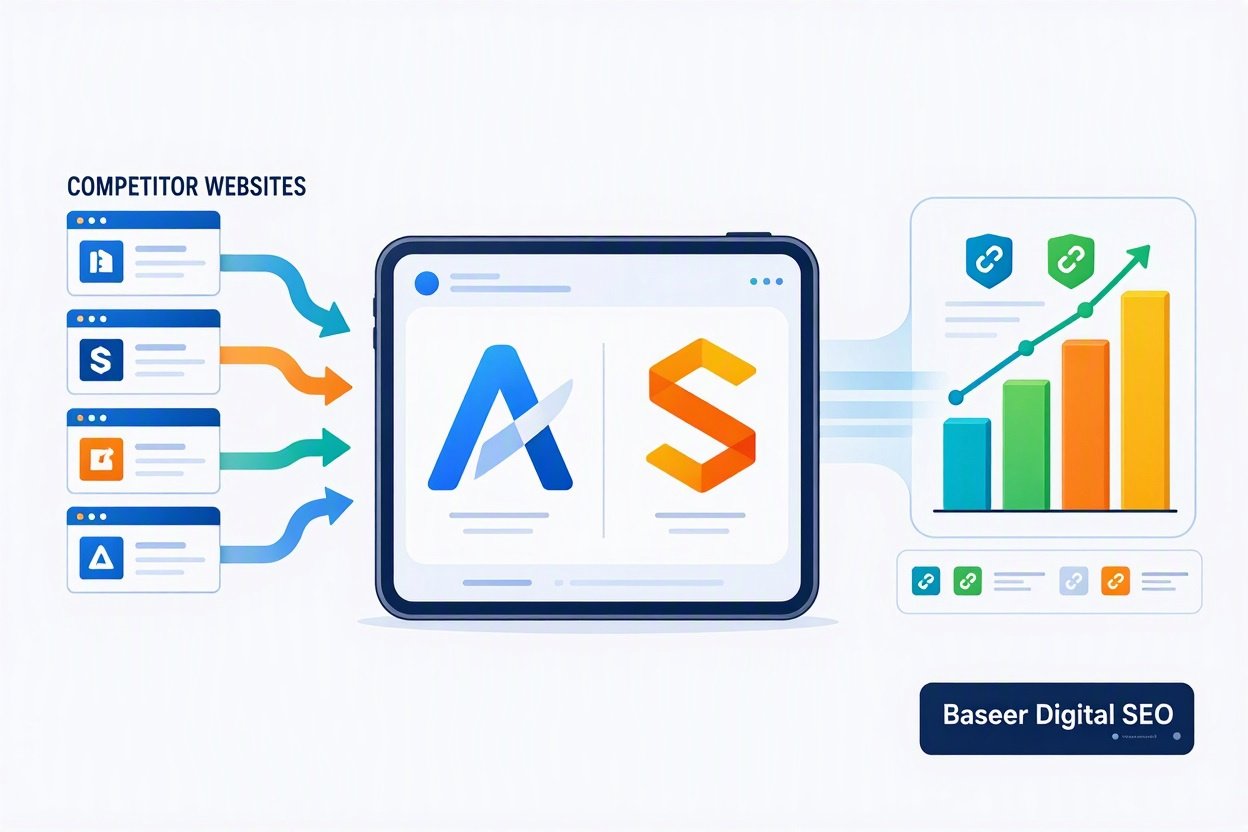
Competitor backlink research is one of the most practical ways to discover where a website can earn relevant, authoritative links. Instead of building a backlink strategy from scratch, marketers can study competitors that already perform well in organic search and identify the websites, publications, and content assets linking to them.
Tools such as Ahrefs and SEMrush make this process significantly easier. They provide backlink databases, referring-domain analysis, anchor-text information, competitor comparisons, and tools for discovering potential link opportunities.
For businesses targeting customers in the United States, United Kingdom, and Canada, competitor backlink research can also reveal which publications and websites matter within specific markets and industries.
This guide explains a practical competitive backlink analysis workflow, including how to use Ahrefs for backlink analysis, how SEMrush can support link research, how to find competitor link gaps, and how to turn the research into an actionable link-building campaign.
What Is Competitor Backlink Research?
Competitor backlink research is the process of analyzing the websites that link to competing domains or pages.
The objective is not simply to copy every backlink a competitor has. Instead, you want to identify patterns and opportunities that may be relevant to your own website.
A competitor backlink analysis can help you discover:
- Industry publications
- Relevant blogs
- Resource pages
- Business directories
- Editorial websites
- Partner websites
- Guest-post opportunities
- Digital PR opportunities
- Unlinked brand opportunities
- Broken-link opportunities
- Content assets that naturally attract links
The most valuable opportunities are usually those where the linking website is relevant to your industry and audience.
Why Competitor Backlink Research Matters for SEO
Backlinks remain an important part of search engine optimization because links can help search engines discover pages and understand relationships between websites.
However, backlink quantity should not be the primary objective.
A competitor may have thousands of backlinks, but many may be irrelevant, duplicated across a site, low-value, or otherwise unsuitable for your strategy.
A better approach is to analyze:
- Link relevance
- Referring-domain quality
- Top-linked pages
- Anchor-text patterns
- Link placement
- Content context
- Geographic relevance
- Potential traffic value
This makes competitor research a strategic exercise rather than a simple backlink-counting process.
Competitor Backlink Research Tools: Ahrefs vs SEMrush
Ahrefs and SEMrush are two widely used SEO platforms for backlink research. Both can help you investigate competitor link profiles, but their interfaces and workflows differ.
| Feature | Ahrefs | SEMrush |
|---|---|---|
| Backlink profile analysis | Yes | Yes |
| Referring domains | Yes | Yes |
| Anchor-text analysis | Yes | Yes |
| Competitor backlink research | Yes | Yes |
| Link gap analysis | Link Intersect | Backlink Gap |
| Domain authority metric | Domain Rating (DR) | Authority Score |
| Top linked pages | Yes | Yes |
| Broken backlink research | Yes | Yes |
| Competitor comparison | Strong | Strong |
| Broader SEO toolkit | Strong | Very strong |
The metrics should not be treated as interchangeable.
For example, Ahrefs Domain Rating (DR) and SEMrush Authority Score are proprietary metrics calculated using different methodologies. A higher number in one platform does not automatically equal the same level of authority in the other.
Step 1: Identify the Right Competitors
Before opening an SEO tool, determine which competitors are actually worth researching.
Your competitors should ideally meet at least one of these criteria:
- Rank for keywords you want to target.
- Serve the same audience.
- Publish content in your industry.
- Compete with your products or services.
- Have strong organic visibility.
- Have a backlink profile relevant to your business.
Don’t Only Research Direct Business Competitors
A website can be a useful SEO competitor even if it does not sell the same products or services.
For example, a software company may compete for search visibility against:
- Industry publications
- Review websites
- Educational blogs
- Comparison websites
- Research platforms
- Industry associations
These websites can sometimes provide more useful backlink opportunities than direct commercial competitors.
Step 2: Analyze a Competitor in Ahrefs
One of the most useful ways to use Ahrefs for backlink analysis is to start with a competitor’s domain.
Enter the competitor’s website into Ahrefs Site Explorer and examine the available backlink information.
Focus on several areas.
1. Domain Rating
Ahrefs uses Domain Rating (DR) as a proprietary metric for estimating the relative strength of a website’s backlink profile.
DR can be useful for comparison, but it should never be the only factor used to evaluate a link opportunity.
A relevant website with strong editorial content may be more useful than a website selected only because it has a high DR.
2. Referring Domains
Look at the number and quality of unique domains linking to the competitor.
A competitor with 5,000 backlinks might have only a few hundred referring domains.
That distinction matters because multiple links from the same website do not represent the same breadth of relationships as links from many independent domains.
3. Backlinks
Review individual backlinks to understand:
- Which pages receive links
- Where links are placed
- What anchor text is used
- Whether links are contextual
- Which websites provide links
- Whether links appear editorial or promotional
4. Best-Linked Pages
Competitor pages with substantial backlinks can reveal content opportunities.
Look for:
- Original research
- Statistics
- Ultimate guides
- Templates
- Industry reports
- Tools
- Case studies
- Data-driven articles
If a competitor’s resource attracts links from many relevant websites, consider whether you can create a more useful or updated resource.
Image Caption: Analyzing a Competitor’s Backlink Profile With Ahrefs

Step 3: Analyze Competitor Backlinks in SEMrush
SEMrush provides another useful approach to competitive backlink research.
Enter the competitor domain into its backlink analysis tools and review:
- Referring domains
- Backlinks
- Authority Score
- Anchor text
- Link attributes
- Link types
- Top linked pages
- New and lost backlinks
SEMrush can be especially useful when you want to combine backlink research with broader competitive SEO analysis.
Authority Score
SEMrush uses Authority Score as its proprietary metric for evaluating domain strength.
As with DR, use this metric as one data point rather than treating it as an absolute measure of backlink quality.
A relevant link from an authoritative industry publication may deserve more attention than a high-metric website that has little connection to your subject.
Step 4: Find Competitor Link Gaps
One of the most valuable applications of competitor research is finding websites that link to competitors but do not link to your website.
This is often called a link gap.
The basic concept is simple:
Competitor A + Competitor B + Competitor C → compare against your website → identify shared referring domains.
If several relevant competitors receive links from the same publication, resource page, or industry website, that domain deserves investigation.
Using Ahrefs Link Intersect
Ahrefs provides Link Intersect, which can be used to compare backlink profiles and identify websites linking to competing domains but not your own.
A practical workflow is:
- Open Link Intersect.
- Add your website.
- Add several relevant competitors.
- Run the comparison.
- Review domains linking to multiple competitors.
- Filter for relevance and quality.
- Open the referring websites.
- Identify the reason each competitor earned the link.
- Determine whether a similar opportunity exists for your business.
Don’t automatically contact every domain returned by the tool.
Instead, manually evaluate each opportunity.
Step 5: Use SEMrush Backlink Gap
SEMrush offers Backlink Gap, which follows a similar competitive research concept.
Add your website and several competing domains to compare backlink profiles.
The results can help reveal:
- Domains linking to multiple competitors
- Domains linking to only one competitor
- Potential missing referring domains
- Competitor-specific opportunities
- New prospects for outreach
The strongest prospects are generally those that combine:
Relevance + authority + editorial potential + realistic acquisition opportunity
Step 6: Evaluate Every Link Opportunity
Finding a competitor backlink is only the beginning.
Before adding a website to your outreach list, evaluate the opportunity carefully.
Check Topical Relevance
Ask:
Does this website make sense for my industry and target audience?
A relevant industry publication may be more valuable to your strategy than an unrelated website with impressive third-party metrics.
Check Organic Visibility
Look for evidence that the website receives genuine search visibility.
Consider:
- Ranking keywords
- Organic traffic trends
- Content quality
- Search visibility
- Publishing consistency
Review the Backlink Profile
A website may have strong metrics but an unnatural or questionable backlink profile.
Look for:
- Excessive irrelevant links
- Obvious paid-link patterns
- Large numbers of low-quality domains
- Repetitive anchor text
- Thin content
- Excessive outbound commercial links
Evaluate Editorial Standards
Ask whether the publication genuinely reviews and publishes useful content.
High-quality editorial standards can make a prospect more attractive for long-term SEO and referral value.
Step 7: Study Why Your Competitor Earned the Link
This is where competitor backlink research becomes much more useful.
Don’t simply record:
Website → Competitor backlink
Instead, record:
Website → Competitor → Linking page → Reason for link
For example, a competitor may have earned a backlink because it published:
- Original research
- A useful statistic
- A detailed guide
- An industry survey
- A free template
- An expert commentary
- A downloadable resource
This tells you what type of asset may attract links from similar websites.
Step 8: Analyze Competitor Anchor Text
Anchor text can reveal how competitors acquire and structure backlinks.
Look for patterns such as:
- Brand-name anchors
- Naked URLs
- Generic anchors
- Partial-match anchors
- Descriptive anchors
Do not copy a competitor’s anchor-text pattern mechanically.
Your backlink profile should develop naturally based on how other websites choose to reference your content.
The objective is to understand the competitor’s link profile, not manufacture an artificial replica.
Step 9: Identify the Competitor’s Most Linked Content
One of the best ways to turn backlink research into a content strategy is to identify pages that attract links.
Look for pages receiving links from multiple referring domains.
Common linkable assets include:
Original Research
Research-backed content can attract citations from publishers and industry websites.
Statistics Pages
Well-organized statistics resources can become useful reference material.
Comprehensive Guides
Detailed educational resources may naturally attract links when they answer a specific industry question thoroughly.
Tools and Templates
Free calculators, templates, checklists, and interactive resources can provide strong reasons for other websites to link.
Industry Reports
Original reports can create opportunities for editorial mentions, digital PR, and content outreach.
Step 10: Build a Competitive Backlink Analysis Workflow
A repeatable workflow makes competitor research much easier.
Use the following process:
Phase 1: Competitor Discovery
Identify 3–5 relevant organic competitors.
Phase 2: Backlink Collection
Analyze each competitor using Ahrefs and/or SEMrush.
Phase 3: Link Gap Analysis
Use Link Intersect or Backlink Gap to identify domains shared by competitors.
Phase 4: Opportunity Filtering
Remove irrelevant, low-quality, duplicate, or unrealistic prospects.
Phase 5: Link Classification
Classify opportunities by type:
- Guest contribution
- Editorial mention
- Resource page
- Digital PR
- Broken link
- Partnership
- Unlinked mention
- Expert contribution
Phase 6: Content Analysis
Determine why competitors earned each important backlink.
Phase 7: Outreach
Develop personalized outreach based on the website and opportunity.
Phase 8: Tracking
Record:
- Prospect
- Website
- Contact
- Opportunity type
- Target page
- Outreach date
- Follow-up date
- Response
- Placement status
This creates a repeatable system instead of random link building.
Ahrefs vs SEMrush: Which Should You Use?
The answer depends on your workflow.
Ahrefs
Ahrefs can be particularly useful when your primary objective is detailed backlink and link-profile research.
It is useful for:
- Backlink analysis
- Referring-domain research
- Link Intersect
- Competitor link discovery
- Best-linked pages
- Anchor-text analysis
- Link-growth monitoring
SEMrush
SEMrush can be useful when backlink research is part of a broader SEO and competitive analysis process.
It can support:
- Backlink analysis
- Backlink Gap
- Authority analysis
- Keyword research
- Competitor research
- Site auditing
- Broader SEO workflows
SEMrush vs Ahrefs Link Building Strategy
Rather than treating the platforms as competitors where only one must be selected, many professional SEO teams use whichever tool best fits the research task.
The important thing is the methodology:
Research → compare → validate → prioritize → create value → outreach → measure
The software is only the research layer.
How to Find Competitor Link Gaps SEO Opportunities
A useful link-gap process should go beyond simply exporting domains.
Use these filters:
| Filter | What to Look For |
|---|---|
| Relevance | Strong connection to your industry |
| Audience | Audience overlaps with your target customers |
| Authority | Established and credible website |
| Organic visibility | Evidence of genuine search visibility |
| Content quality | Useful, original, well-maintained content |
| Editorial potential | Genuine reason to reference your site |
| Link context | Relevant contextual placement |
| Acquisition method | Realistic and ethical opportunity |
Prioritize opportunities that satisfy several of these criteria rather than focusing on a single metric.
How to Turn Competitor Research Into a Link-Building Campaign
After identifying prospects, group them into campaigns.
Campaign 1: Editorial Outreach
Target publishers where your research or expertise could contribute to an existing article.
Campaign 2: Guest Contributions
Identify websites that accept high-quality expert contributions where appropriate.
Campaign 3: Linkable Assets
Create original research, statistics, guides, tools, or resources designed to earn editorial references.
Campaign 4: Digital PR
Use original data, expert commentary, surveys, and industry insights to attract media coverage.
Campaign 5: Broken-Link Opportunities
Find relevant broken resources and determine whether your existing content provides a useful replacement.
Common Competitor Backlink Research Mistakes
Focusing Only on DR or Authority Score
Third-party metrics are useful for prioritization but do not independently establish whether a backlink is valuable.
Copying Every Competitor Link
Your competitors may have backlinks that are irrelevant, outdated, low-quality, or unsuitable for your business.
Ignoring Link Context
A backlink’s surrounding content matters.
A relevant contextual reference can provide a very different opportunity from a generic sitewide link.
Measuring Success by Link Count
More backlinks do not automatically mean better SEO performance.
Track broader outcomes such as:
- Referring-domain quality
- Organic visibility
- Ranking improvements
- Referral traffic
- Content performance
- Qualified leads
Using Generic Outreach
Once you identify a prospect, personalized outreach is generally more useful than sending identical messages to every website.
Image Caption: Finding Competitor Link Gaps and Prioritizing SEO Opportunities

A Practical Competitor Backlink Research Checklist
Before starting outreach, use this checklist:
- Identify 3–5 relevant competitors
- Analyze competitor domains
- Review referring domains
- Examine top backlinks
- Analyze top-linked pages
- Review anchor-text patterns
- Compare competitor link profiles
- Run Link Intersect or Backlink Gap
- Remove irrelevant prospects
- Check website quality
- Evaluate organic visibility
- Identify the reason for each valuable backlink
- Categorize opportunities
- Create relevant content or resources
- Personalize outreach
- Track responses and placements
- Monitor results over time
Final Thoughts
Competitor backlink research can give your SEO strategy a significant advantage because it reveals how successful websites acquire links, which publications reference them, and what types of content attract attention.
The most effective approach is not to copy a competitor’s backlink profile.
Instead, use Ahrefs and SEMrush to discover patterns, identify link gaps, evaluate opportunities, and understand the content and relationships behind valuable backlinks.
A strong competitive backlink analysis workflow combines technology with human judgment. Metrics can help you discover prospects, but relevance, editorial quality, audience alignment, and the reason behind a link should determine whether an opportunity deserves further attention.
If you want to build a stronger backlink profile, start with a small group of genuine competitors, identify their most valuable referring domains, find the gaps in your own profile, and turn the best opportunities into a focused outreach campaign.
Start your competitor backlink research today, build a qualified prospect list, and use the insights to create a more relevant and sustainable link-building strategy.
SEO Keywords
Primary Keywords
- competitor backlink research tools
- how to use Ahrefs for backlink analysis
- SEMrush vs Ahrefs link building strategy
- find competitor link gaps SEO
- competitive backlink analysis workflow
Secondary Keywords
- competitor backlink analysis
- backlink gap analysis
- Ahrefs competitor research
- SEMrush backlink analysis
- competitor link building
- referring domain analysis
- backlink profile analysis
- SEO competitor research
Long-Tail Keywords
- how to analyze competitor backlinks
- how to find competitor backlinks using Ahrefs
- how to use SEMrush for competitor backlink research
- how to find link gaps between competitors
- best workflow for competitive backlink analysis
- how to identify high-quality competitor backlinks





Leave a Reply