
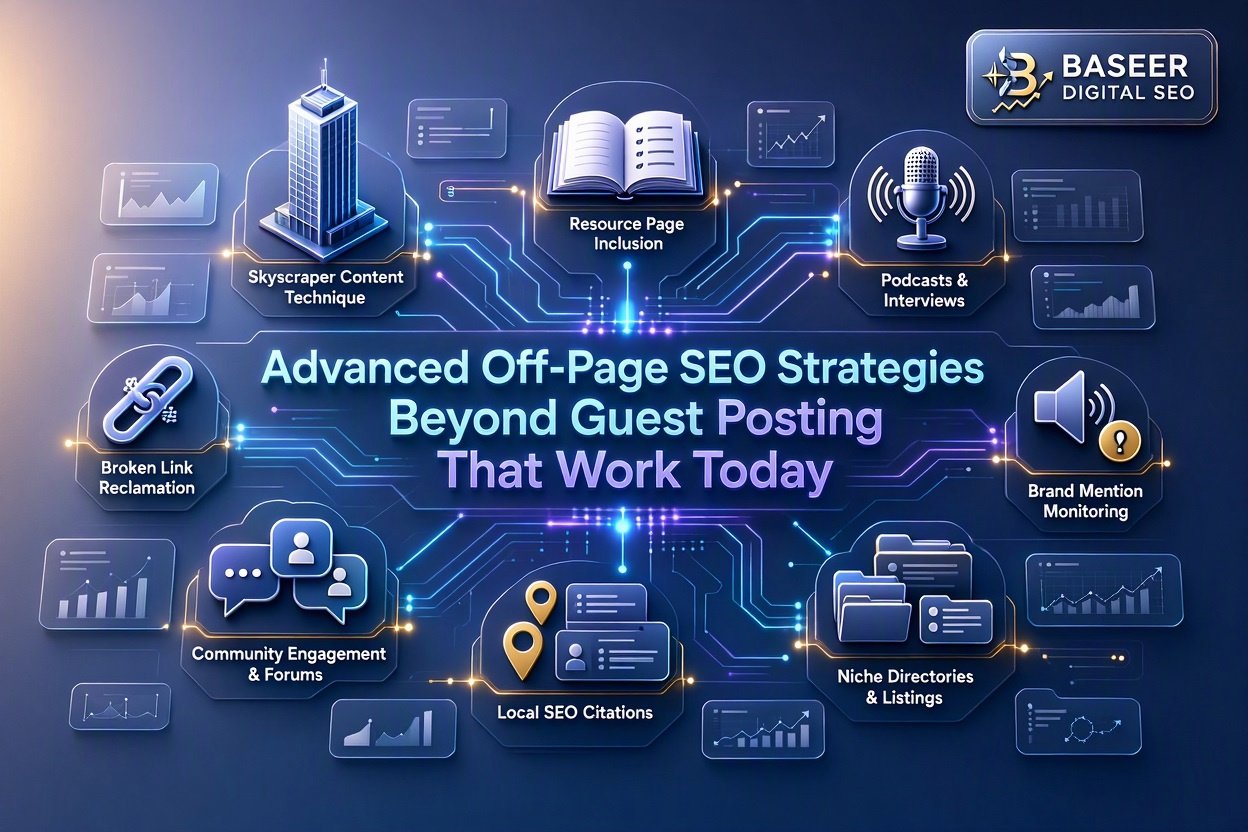
If your link-building plan still starts and ends with finding websites that accept guest posts, it may be time to broaden your approach.
Guest posting can still play a useful role in SEO, but modern authority building is no longer about repeating one tactic at scale. Search visibility depends on a much wider mix of factors, including relevant backlinks, editorial mentions, digital PR, brand recognition, community participation, reputation, and relationships with publishers and industry professionals.
That is where a modern off-page SEO strategy becomes important.
For businesses competing in the USA, UK, and Canada, the goal should not simply be to acquire more links. The goal is to build a credible online presence that other websites, journalists, communities, and customers naturally recognize and reference.
This guide explains what off-page SEO really involves, why it matters, and which advanced strategies can help businesses build authority beyond traditional guest posting.
What is off-page SEO?
Off-page SEO refers to activities that happen outside your own website and can help strengthen its visibility, authority, relevance, and reputation in search.
You may also hear the term off-site SEO, which is commonly used to describe the same broad concept.
Backlinks are an important part of off-page SEO, but they are not the entire picture. Modern off-page work can include:
- Editorial backlinks
- Brand mentions
- Digital PR
- Guest posting
- Niche edits
- Resource page links
- Community participation
- Social media visibility
- Online reviews
- Unlinked brand mentions
- Industry relationships
- Content promotion
For example, imagine a software company based in London publishes an original study about productivity trends among UK businesses. A business publication references the research, a technology journalist mentions the company, and several industry professionals share the report on LinkedIn.
There may be only a few direct links involved, but the company has gained something more valuable than a collection of URLs: visibility and credibility.
That is the bigger idea behind off-page SEO. Your website becomes stronger when reputable people, publications, communities, and businesses have legitimate reasons to talk about it.
On-Page SEO vs. Off-Page SEO
On-page SEO and off-page SEO serve different purposes, but they work best together.
On-page SEO focuses on elements you control directly on your website. This includes content quality, headings, title tags, internal links, images, structured data, and other page-level elements.
Off-page SEO focuses on signals and activities occurring outside your website, such as backlinks, brand mentions, PR coverage, reviews, and community discussions.
Technical SEO is another important part of the equation because search engines need to be able to crawl, render, and index your website properly.
| SEO Area | Main Focus | Examples |
|---|---|---|
| On-Page SEO | Improving individual pages | Content, headings, title tags, internal links |
| Technical SEO | Crawling and website accessibility | Site speed, mobile usability, XML sitemaps, HTTPS |
| Off-Page SEO | Building external authority and visibility | Backlinks, PR, mentions, reviews, communities |
Think of it this way: your on-page and technical work make your website worth discovering, while off-page SEO activities help establish why other people should trust, reference, and recommend it.
A Canadian e-commerce business, for instance, might publish an excellent buying guide. On-page optimization can make the guide easier for search engines to understand, but relevant mentions from industry publications and links from trusted websites can help the content gain broader authority and exposure.
Why does off-page SEO matter for search engine rankings?
Search engines need signals that help them understand which websites and pages deserve attention. External references can provide useful evidence about a site’s relevance, reputation, and authority.
Links are particularly important because they connect websites and help search engines discover relationships between pages. However, modern SEO should not be reduced to collecting as many links as possible.
The quality, relevance, context, and credibility of external references matter.
Off-page SEO can also produce benefits beyond rankings. A successful campaign can generate referral traffic, increase brand awareness, attract potential customers, create media relationships, and establish a business as a recognizable name within its industry.
Links and mentions influence rankings
Backlinks remain an important part of link building, but the source and context of a link matter.
Consider two scenarios.
One website receives a link from a respected industry publication where the surrounding article is directly related to its expertise. Another receives dozens of links from unrelated websites created primarily to host advertisements and links.
The number of links may look impressive in the second example, but the first situation is much more meaningful from a relevance and credibility perspective.
Important considerations include:
- Relevance: The referring website and surrounding content should make sense for your industry.
- Editorial context: A naturally placed reference within useful content is generally more valuable than an arbitrary sitewide link.
- Source quality: Look for websites with genuine audiences and editorial standards.
- Anchor text: Maintain a natural mix rather than forcing exact-match commercial keywords repeatedly.
- Potential referral traffic: A good link should ideally have the potential to introduce real visitors to your website.
Brand mentions matter too. A company can be discussed online even when the reference does not contain a hyperlink. These mentions can contribute to brand visibility and may create opportunities to reclaim an unlinked reference where appropriate.
The key lesson is simple: backlink quality should matter more than backlink quantity.
Off-page SEO influences your domain and page authority
Domain authority is a third-party SEO metric developed by Moz. Other platforms use comparable metrics, such as Ahrefs’ Domain Rating and Semrush’s Authority Score.
These metrics can be useful for comparing websites and evaluating link profiles, but they are not direct Google ranking factors.
A website with a high third-party authority score is not automatically guaranteed higher rankings.
Page-level authority can also vary considerably. One page may attract many strong external references while another page on the same domain receives very little attention.
When evaluating authority, consider:
- Relevance of referring domains
- Quality of external websites
- Number and diversity of referring domains
- Editorial context
- Organic visibility
- Audience relevance
- Overall reputation
A smaller specialist publication that serves exactly the audience you want to reach may be a better opportunity than a large but completely unrelated website.

Link Building Beyond Traditional Guest Posting
Guest posting is only one method of acquiring visibility and links. An advanced off-site SEO strategy should combine several approaches rather than depending entirely on contributed articles.
The right mix will depend on your industry, resources, competition, and the type of content your audience finds useful.
High-Quality Backlinks and Link Relevance
Not all SEO backlinks carry the same value.
Strong links typically come from websites that have:
- Genuine editorial content
- A relevant audience
- A legitimate publishing history
- Topical relevance
- Natural outbound linking practices
- Useful content that people actually read
High-quality backlinks should fit naturally into the surrounding content. A link to a cybersecurity guide from a technology publication makes sense. A random link to the same guide from an unrelated entertainment site simply because the site has a high metric is much harder to justify.
Avoid judging opportunities based solely on Domain Authority, Domain Rating, or similar scores.
Instead, ask whether the website is genuinely relevant, trustworthy, and useful to your target audience.
Digital PR and Brand Mentions
Digital PR has become one of the most effective ways to earn attention and potentially attract editorial links.
Instead of directly asking hundreds of websites to link to you, create something that journalists and publishers have a reason to reference.
Potential digital PR assets include:
- Original research
- Industry surveys
- Consumer trend reports
- Expert commentary
- Data studies
- Unique statistics
- Interactive tools
- Calculators
- Original visualizations
For example, a Toronto financial technology company could publish research analyzing how Canadian small businesses are adapting to changing payment preferences. A journalist covering Canadian business trends may reference the research when writing an article.
The strength of this approach is that the link becomes a byproduct of useful information rather than the only reason the content exists.
Avoid sending generic press releases to hundreds of unrelated publications. Good PR starts with a credible story and a clear reason for journalists to care.
Niche Edits and Contextual Link Placements
Niche edits, also known as contextual link insertions, involve adding a relevant reference to an existing article.
This can work when the resource genuinely improves the page.
For example, an established marketing article explaining content distribution may benefit from referencing a detailed research report or original guide that provides additional evidence.
However, quality control is essential.
Avoid bulk link packages where the same website network sells hundreds of placements across unrelated niches. Paid links intended to manipulate search rankings can create SEO risks.
A legitimate contextual reference should make sense for both the publisher and its readers.
Resource Page Link Building
Resource pages can provide valuable opportunities for websites that have genuinely useful assets.
Potential assets include:
- Industry guides
- Research reports
- Calculators
- Templates
- Checklists
- Educational resources
- Original studies
For example, a UK sustainability company might create a detailed household energy-saving calculator and approach relevant environmental organizations or educational websites that maintain useful resource lists.
The important part is relevance. Do not ask to be added to a resource page simply because it contains a link.
Broken Link Building
Broken link building involves finding external pages that link to outdated or unavailable resources and suggesting a suitable replacement.
A useful workflow is:
- Find relevant websites.
- Identify broken outbound links.
- Review the original resource.
- Create or identify a genuinely relevant replacement.
- Contact the site owner with the exact problem.
- Explain why your resource is a suitable alternative.
Tools such as Ahrefs, Semrush, and Screaming Frog can help identify broken links and backlink opportunities.
This approach works best when your replacement is genuinely useful rather than created solely to obtain a link.
Competitor Backlink Analysis
Your competitors can reveal useful information about the link environment in your industry.
Review several competitors and look for patterns such as:
- Publications linking to multiple competitors
- Industry associations
- Resource pages
- Media coverage
- Research citations
- Podcasts and interviews
- Industry directories
- Partnerships
- Content formats that consistently attract links
The objective is not to copy every backlink.
Instead, competitor analysis should help answer a better question:
What types of content, relationships, and resources earn attention in this market?
You can then create something stronger or pursue opportunities that competitors have overlooked.
Linkable Assets and Original Research
Some content is naturally easier to reference than ordinary blog posts.
Examples include:
- Original research
- Industry statistics
- Free calculators
- Interactive tools
- Comprehensive reports
- Original datasets
- Expert surveys
- Detailed industry guides
A strong linkable asset gives publishers a genuine reason to mention your business.
For businesses in competitive USA, UK, and Canadian markets, investing in original data can be especially valuable because journalists and publishers constantly need credible sources for their reporting.
Where Guest Posting Fits In
Guest posting still has a place in modern SEO when it is approached as genuine publishing rather than a link-placement exercise.
A strong guest posting campaign should prioritize:
- Relevant publications
- Real audiences
- Original content
- Editorial standards
- Subject-matter expertise
- Useful information
- Natural contextual references
- Long-term publisher relationships
The strongest guest contributions should still be worth publishing even if the backlink were removed from the equation.
Avoid websites that openly sell large quantities of links, publish content from every imaginable niche, or appear to exist mainly for SEO placements.
Guest posting can support an SEO link building campaign, but it should be one part of a larger strategy.
Off-page strategies that work
Modern off-page SEO techniques extend well beyond traditional backlinks.
The strongest campaigns combine link acquisition with brand visibility, relationships, community participation, digital PR, and reputation management.
The goal is to create a recognizable business that people have legitimate reasons to reference.
User-generated content (UGC) on forums like Reddit and Quora
Online communities can provide valuable opportunities to demonstrate expertise and interact with potential customers.
Platforms such as Reddit and Quora should not be treated as places to drop links repeatedly. Their value comes from participating in conversations where your knowledge can genuinely help.
Effective participation includes:
- Answering questions thoroughly
- Providing useful explanations
- Sharing experience and expertise
- Following community rules
- Being transparent about business affiliations
- Linking to resources only when genuinely relevant
- Building a history of useful contributions
For example, a software company serving US small businesses could answer questions about choosing project-management tools without immediately promoting its own product.
If the community allows it and a detailed guide on the company’s website provides additional value, a relevant reference may be appropriate.
What should you avoid?
- Fake accounts
- Copy-pasted answers
- Mass commenting
- Excessive self-promotion
- Manipulated voting
- Coordinated engagement
- Irrelevant links
Community participation is primarily about credibility and visibility, not acquiring hundreds of backlinks.
Social Media and Off-Page SEO
Social platforms can support broader off-page SEO optimization by helping content reach people who may eventually reference, share, discuss, or link to it.
Social activity should not be presented as a direct Google ranking factor. Its value is largely indirect.
Social Signals and Brand Visibility
A useful research report shared through LinkedIn, YouTube, X, or another relevant platform may reach journalists, publishers, researchers, and industry professionals.
Those people may later discover the original content and reference it from their own websites.
This makes social distribution an important supporting activity.
Building a Strong Brand Presence
Consistency matters across social profiles.
Keep your:
- Business name
- Description
- Website information
- Branding
- Industry positioning
- Contact details
consistent where appropriate.
Share useful insights instead of turning every post into a sales pitch. A recognizable brand is more likely to be remembered when journalists, publishers, or potential customers need information in your industry.
Online Reputation and Brand Authority
SEO does not exist separately from reputation.
A company may rank well but still lose customers if its public reputation is poor. Online reputation management helps businesses monitor and improve how they are represented across search results, review platforms, social networks, publications, and other online environments.
Brand Mentions Without Backlinks
Unlinked brand mentions can represent useful opportunities.
Businesses can monitor mentions using tools such as Google Alerts, Ahrefs, or dedicated brand-monitoring platforms.
When a reputable website mentions your company but does not link to it, you can contact the publisher politely and ask whether adding a relevant reference would help readers.
Not every mention needs to become a link. The primary objective should remain genuine visibility.
Managing Online Reviews and Reputation
Reviews are particularly important for local businesses.
A dental practice in Toronto, a roofing company in Texas, or a professional services firm in London may depend heavily on how customers perceive its reputation online.
Good reputation practices include:
- Encouraging genuine customers to leave honest feedback
- Responding professionally to negative reviews
- Correcting inaccurate business information
- Monitoring important review platforms
- Avoiding fake or purchased reviews
- Maintaining consistent business information
Never fabricate reviews or manipulate customers into leaving misleading feedback.
Domain Authority, Page Authority, and Link Quality
Third-party authority metrics can be useful when comparing potential link opportunities, but they should never become the entire SEO strategy.
When reviewing a potential referring domain, ask:
- Is the website relevant to my industry?
- Does it have a genuine audience?
- Does it appear to publish useful content?
- Does it have organic visibility?
- Are its outbound links natural?
- Would my target audience benefit from discovering my website there?
- Would I still value the mention if search engines did not exist?
If the answer is yes to most of these questions, the opportunity may be worthwhile even if the site’s third-party metric is not extremely high.
This is a much healthier approach than chasing authority scores alone.
Common Off-Page SEO Mistakes to Avoid
Several mistakes can weaken an otherwise promising campaign.
Buying Low-Quality Links
Large quantities of low-quality links can create risk and rarely provide sustainable value.
Over-Optimizing Anchor Text
Using the same commercial keyword in every backlink can make a profile appear unnatural. A healthy link profile generally contains a natural variety of branded, URL, descriptive, and other anchor types.
Spamming Forums
Posting links across Reddit, Quora, comments, and unrelated communities can damage credibility and lead to account restrictions.
Relying Only on Guest Posting
Guest posting can work, but depending on one tactic makes your campaign less flexible.
Chasing Authority Metrics
A high Domain Authority score does not automatically mean a website will rank well for your target keywords.
Ignoring Relevance
A link should make sense within the context of the page and the audience.
Automating Everything
Automated outreach, automated comments, and mass-generated placements often sacrifice quality for volume.
A better off-site SEO optimization approach focuses on relevance, relationships, useful content, and sustainable growth.
How to Build an Advanced Off-Page SEO Strategy
A practical off-page SEO strategy can be built in stages.
1. Audit Your Existing Backlinks
Review your referring domains, anchor text, link relevance, and overall backlink profile.
2. Study Your Competitors
Identify publications, organizations, resources, and content formats that link to competitors.
3. Build Better Linkable Assets
Create resources that publishers genuinely want to reference.
4. Develop Publisher and Media Relationships
Instead of sending generic outreach messages, build relationships with relevant editors, journalists, and industry professionals.
5. Combine Multiple Link Acquisition Methods
Use a balanced mix of digital PR, editorial outreach, resource pages, broken link opportunities, niche-relevant placements, and carefully selected guest contributions.
6. Reclaim Brand Mentions
Look for reputable websites that mention your business without linking to it.
7. Participate in Relevant Communities
Share useful expertise in industry communities without turning every discussion into promotion.
8. Monitor Performance
Track links, referring domains, organic visibility, referral traffic, rankings, mentions, and conversions.
9. Improve Based on Evidence
Keep investing in strategies that produce meaningful results and reduce activities that generate little value.

How to Measure Off-Page SEO Results
Measuring results requires more than checking how many links were acquired.
Track several indicators together:
- Referring domains
- Relevant backlinks
- Organic traffic
- Keyword rankings
- Search visibility
- Referral traffic
- Brand mentions
- Branded searches
- Leads and conversions
- Assisted conversions
- Link quality
- Authority trends
For example, gaining 30 new links may look impressive, but if none are relevant and they produce no referral traffic or measurable visibility improvement, the campaign may need to change.
On the other hand, a smaller number of highly relevant editorial links can generate meaningful referral traffic and stronger brand exposure.
SEO results also take time. Evaluate progress over meaningful periods rather than judging a campaign based on a few days of movement.

Off-Page SEO Checklist
Use this off-page SEO checklist when reviewing your strategy:
- Audit your existing backlink profile
- Analyze competitor referring domains
- Prioritize relevance over raw authority metrics
- Identify high-quality backlink opportunities
- Create linkable assets
- Develop original research where possible
- Build relationships with publishers and journalists
- Use digital PR for genuinely newsworthy stories
- Pursue relevant resource pages
- Find legitimate broken link opportunities
- Reclaim relevant unlinked brand mentions
- Use niche edits selectively and editorially
- Contribute valuable guest posts
- Participate honestly in relevant communities
- Maintain consistent social profiles
- Monitor online reviews and reputation
- Track new and lost backlinks
- Measure referral traffic
- Monitor organic visibility and rankings
- Review results regularly and adjust the strategy

Frequently Asked Questions About Off-Page SEO
What is off-page SEO?
Off-page SEO includes activities outside your website that can help build authority, visibility, relevance, and reputation. Backlinks, digital PR, brand mentions, reviews, and community participation are common examples.
What is the difference between on-page and off-page SEO?
On-page SEO focuses on elements you control on your website, while off-page SEO focuses on external signals such as backlinks, mentions, reputation, and relationships.
Are backlinks still important for SEO?
Yes. Backlinks remain an important part of SEO, particularly when they are relevant, editorially appropriate, and earned from credible websites. Quality and context are more important than simply increasing the number of links.
Is guest posting still effective?
Yes, when it is done properly. Relevant publications, useful original content, genuine audiences, and strong editorial standards are more important than publishing large numbers of guest posts.
What makes a backlink high quality?
A high-quality backlink generally comes from a relevant and trustworthy website, appears naturally within useful content, has genuine audience value, and makes sense in context.
Does social media help SEO?
Social media can support SEO indirectly through content discovery, brand awareness, referral traffic, and relationships with publishers and industry professionals. Social likes and followers should not be treated as direct Google ranking factors.
Is Domain Authority a Google ranking factor?
No. Domain Authority is a third-party metric developed by Moz. It can be useful for SEO analysis, but Google does not use Domain Authority as a direct ranking factor.
How can businesses build backlinks without guest posting?
Businesses can earn links through digital PR, original research, resource pages, broken link building, useful tools, linkable assets, expert commentary, legitimate partnerships, and unlinked brand mention reclamation.
How long does off-page SEO take to show results?
The timeline varies depending on competition, website strength, industry, content quality, and the strategies being used. Meaningful SEO improvements often require consistent effort over several months rather than a few weeks.
What are the safest off-page SEO techniques?
Focus on earning legitimate editorial references, publishing useful content, building genuine relationships, participating honestly in communities, promoting original research, and maintaining a strong online reputation.
Conclusion
Advanced off-page SEO is no longer about collecting as many backlinks as possible.
Guest posting can still be useful, but it should sit inside a much broader strategy that includes digital PR, relevant editorial links, original research, brand mentions, community participation, social distribution, reputation management, and genuine relationships.
The strongest off-page SEO techniques are built around a simple principle: give other people a legitimate reason to reference your business.
For businesses competing in the USA, UK, and Canada, that means creating useful resources, earning credible coverage, developing industry relationships, and consistently building a reputation that extends beyond the website itself.
Start with a backlink audit, study your competitors, identify gaps in your market, and create one genuinely valuable asset that others can reference. Then build relationships and promote it strategically.
That approach takes more thought than simply ordering another batch of links, but it creates a stronger foundation for long-term search visibility, brand authority, and sustainable off-site SEO growth.




Leave a Reply