
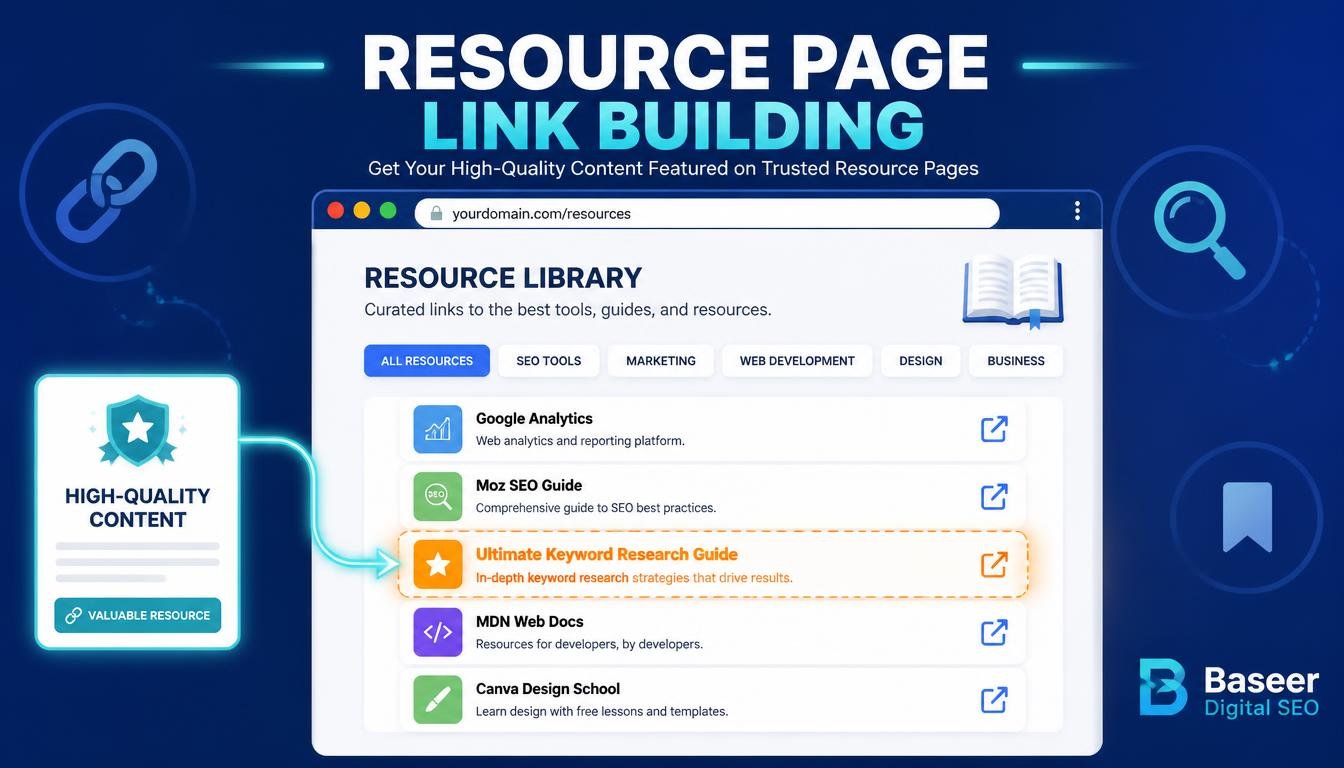
Ask any link builder what they dread most and you’ll hear the same thing: the cold email that gets ignored. Fifty sent, two answered, one of those asking for cash. Resource page link building sidesteps a lot of that misery, and the reason is pretty simple. The person on the other end already runs a page full of recommendations. You’re not begging for a favor, you’re suggesting one more thing their readers might need.
Think of a university library’s list of budgeting tools, a city council’s directory for small business support, or a charity’s collection of mental health organizations. Somebody keeps those pages tidy, and good additions make their job easier. If your content fits, you’ve done them a service.
Below, I’ll walk through what the tactic involves, which content actually earns a placement, how to find and size up the right pages, how to word a pitch that doesn’t read like a pitch, and how to judge whether any of it paid off. The examples lean towards readers in the US, UK, and Canada, so you’ll see things like Ontario tenant guides and HMRC deadlines instead of vague hypotheticals.
What Is Resource Page Link Building?
A resource page exists to send visitors somewhere useful. Resource page link building is the job of hunting those pages down, deciding which ones your content genuinely belongs on, and asking the owner to consider adding it.
It’s one corner of link building, and probably the most honest one, because the trade is out in the open. The owner gets something helpful for their audience; you get a link on a page that’s already about your subject. Those make for some of the best SEO backlinks you can earn, since the whole point of the page is recommendation.
Don’t expect consistent naming. You’ll run into “useful links,” “recommended reading,” “toolkit,” “further resources,” “helpful organizations,” and a dozen other labels. What matters is what the page does, not what it’s called.
What Makes a Page a Linkable Resource?
Curators get a steady trickle of requests, so they’ve learned to be choosy. In my experience of how these pages are built, the ones that get linked tend to answer a narrow question really well, offer something you can’t find on the next site (original data, a calculator, a template, a genuinely clear guide), stay accurate over time, work on a phone, and come from someone you can identify.
A 600-word blog post that repeats what everybody already knows rarely gets a look. A free mortgage affordability calculator, a plain-English walkthrough of UK Self Assessment deadlines, or a searchable directory of Canadian small business grants has a fighting chance, because a visitor can use it the moment they land.
How Resource Pages Support SEO Link Building
Search engines read links as a hint about relevance and trust, and where a link sits matters. One from a page tightly focused on your topic says more than one dropped into a random directory. Resource pages also tend to belong to real organizations with real audiences, which means the links on them are usually editorial rather than bought.
There’s a side effect people overlook: these pages often rank, so a placement can keep sending referral visitors for years after you’ve moved on to other work. Useful, yes. A cure-all, no. It belongs alongside your other link building strategies, not in place of them.
What Kind of Content Works Best for Resource Page Link Building
Most people get the order backwards. They polish the email first and worry about the page later. Flip that. If the thing you’re promoting isn’t something a curator would happily recommend, the best template in the world won’t rescue it.
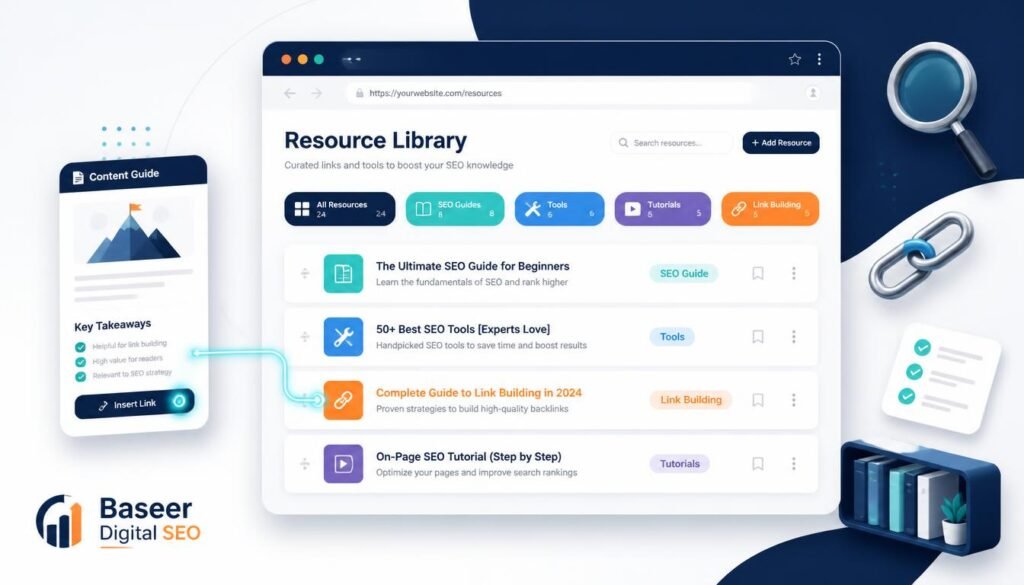
Create Useful, Link-Worthy Content
Link-worthy content is specific, practical, and better than what’s already listed. So before you pitch anyone, open their page and read through the links it currently has. Then ask yourself, honestly, what yours adds. Newer figures? A clearer explanation? A tool that saves someone twenty minutes?
Here’s a quick gut check. Could the curator sum up your page in a single sentence? “A free checklist for preparing a UK tax return” passes easily. “Our thoughts on tax season” doesn’t, and nobody will list it.
Examples of Resources That Attract Backlinks
A handful of formats keep showing up on resource pages for backlinks. Free tools are the obvious one, say a Canadian RRSP contribution calculator or a US freelance tax estimator. Original research does well too, whether that’s your own survey or a careful reading of public numbers from the Census Bureau or the Office for National Statistics. Then there are long-form guides to genuinely painful processes, like applying for a US small business loan, which can quietly become the page everyone recommends.
Downloadable templates such as budget spreadsheets, contract outlines, and checklists get bookmarked and passed around. Glossaries work when they fill a real gap, for instance a plain-language list of home-buying terms for first-time buyers in Ontario.
Whichever format you pick, think about who’ll be reading the target page. A university careers office wants something quite different from a trade association’s members’ area.
Resource Page Link Building Techniques: A Step-by-Step Guide
Treat this as a routine you can repeat, not a one-off burst of effort.
How to Find Resource Pages
Knowing how to find resource pages is honestly half the work. They exist in nearly every niche; they just don’t always announce themselves.
Use Google Search Operators for Link Building
Google search operators for link building let you cut through the noise. Pair your topic with phrases curators tend to use, like these:
"your topic" inurl:resources"your topic" intitle:"useful links""your topic" "recommended resources""your topic" intitle:"further reading"
You can also narrow by domain type. Adding site:.edu pulls up US universities, site:.ac.uk covers UK academic sites, site:.gov.uk and site:.gc.ca find government pages, and site:.org leads you to charities and associations. A word of caution, though: .edu and .gov pages frequently have strict inclusion rules, so read them before you hit send.
Find Link Building Opportunities in Your Niche
Operators aren’t the only way to find link building opportunities. Look at which resource pages already link to your competitors; if a page lists three of your rivals, it’s plainly open to newcomers. Local angles are underrated, too. City councils, chambers of commerce, and Canadian provincial associations often maintain lists for residents and businesses, and they get far fewer pitches than the big national sites.
You can also search your topic with words like “toolkit,” “starter pack,” or “support services,” and browse professional bodies and charities connected to your subject. Whatever you find, keep a plain spreadsheet with the URL, the owner, a contact name, and a few notes. Future you will be grateful.
Evaluate Resource Page Quality
Not every page deserves your effort. Five minutes of screening can save you hours of outreach that goes nowhere.
Check Topical Relevance and Editorial Quality
Start with relevance. Does the page really cover your subject, and would your link sit comfortably beside the others? After that, look for signs that someone cares about the page: recent updates, working links, a sensible selection rather than a dumping ground, and a site run by an organization you can actually identify. A tidy page with twelve well-chosen links usually beats a sprawling list of three hundred.
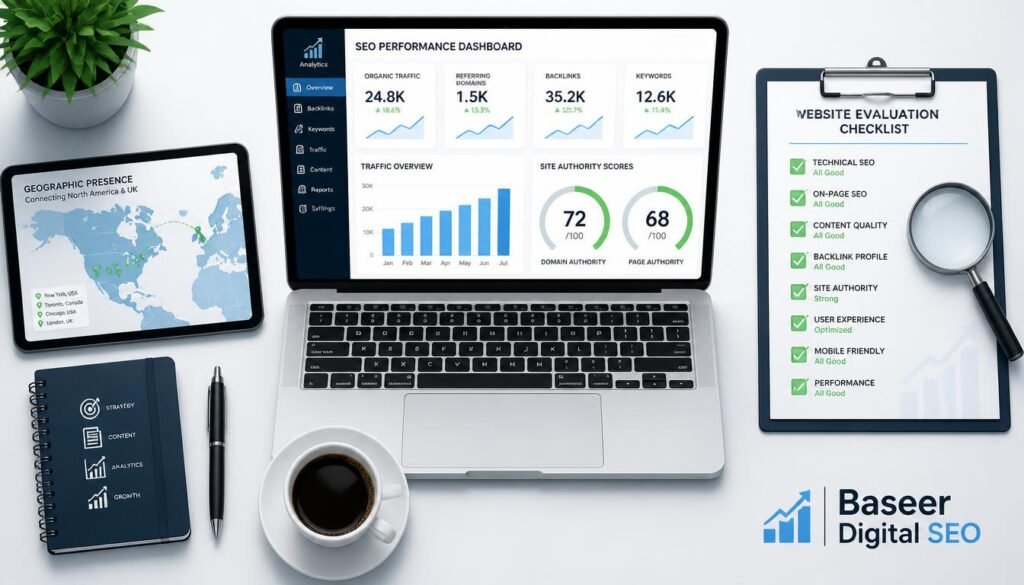
Assess Domain Authority and Domain Rating Carefully
Domain authority comes from Moz and domain rating comes from Ahrefs. Both are outside estimates of how strong a site’s backlink profile looks, which makes them handy for sorting a long prospect list. They’re not Google’s numbers, though, and they miss plenty.
So use them as a rough filter. A small local charity with a modest score can be far more relevant, and better trusted in its field, than a high-scoring site with no connection to your topic. Judge relevance and editorial standards first, and let the scores settle ties.
Prepare a Relevant Outreach Pitch
Good backlink outreach is brief, specific, and mindful of the other person’s time. You’re not trying to talk anyone into something. You’re trying to make “yes” the obvious answer because your resource clearly belongs.
How to Write a Resource Page Outreach Email
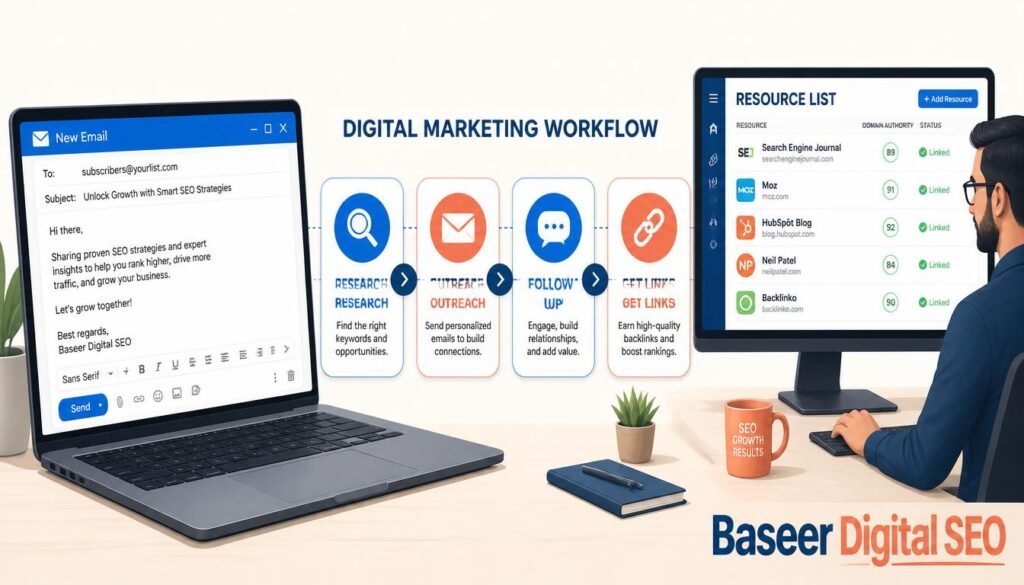
A solid resource page outreach email has four moving parts. Begin with a plain subject line such as “Suggestion for your small business funding page” (hype gets deleted). Open by naming the page and saying what you found useful about it. Then describe your resource in a sentence or two and explain where it fits. Finish by thanking them and leaving the call to them.
Here’s roughly how that sounds:
Hi Sarah,
I came across your list of tenant rights resources for renters in Ontario and found it really well organized. I noticed it doesn’t cover rent increase rules yet, and we recently published a plain-language guide to how the guideline works, with a worked example for a typical lease.
If it’s useful for your readers, here’s the link: [URL]. Either way, thanks for keeping such a helpful page going.
Best,
Daniel
There’s no gushing in there, no demand, and not a word about SEO. It reads like one person pointing out something to another, which is exactly the idea.
Personalize Your Link Building Outreach
Personalization is what lifts link building outreach out of the inbox noise. Use the page’s name, write to the right person, and say why your content suits their particular readers. If you can point to a real gap on their page, that’s gold.
It’s fine to keep a loose skeleton, but rewrite the opening and the reasoning each time. Follow up once, around a week later. After that you’re edging towards pushy.
What to Avoid in Resource Page Link Building
Some mistakes sink campaigns faster than anything else. The biggest is pitching pages where your content doesn’t fit; if it isn’t relevant, leave it out of the send list. Close behind is blasting the same template to everyone, which curators spot almost instantly. Oversell and you lose trust too, so describe what the resource does and skip the superlatives.
Don’t offer money for a placement either, since paid links that pass ranking signals can run against Google’s spam policies. Read and follow any submission rules a page spells out. Resist telling the owner what anchor text to use, because they’ll describe your link in their own words. And don’t chase only the big names, as a smaller, tightly relevant page often performs better than a famous one that doesn’t quite fit.
Bonus Tip: Look for Broken Links on Resource Pages
While you’re vetting a page, click through its links. Found a dead one? That’s your opening. This is broken link building in a nutshell: you let the owner know about the broken link and, if your content is a fair replacement, suggest it.
It pairs well with everything above because you’re helping first and asking second. The Check My Links Chrome extension handles small pages, while the crawlers inside Ahrefs and Semrush cope with bigger ones.
Benefits and Limitations of Resource Page Link Building
Every tactic has strengths and weak spots, and knowing both helps you decide how much of your week this one deserves.
How Resource Pages Can Help Earn High-Quality Backlinks
When a placement lands, the upside is real. The link sits on a page about your topic, which strengthens the relevance signal. A human chose to include you, and that counts for more than a link you placed yourself. Maintained pages can hold a link for years, and the visitors who click are already looking for help with your subject. Best of all, universities, nonprofits, and trade bodies can open the door to high-quality backlinks that are hard to get any other way.
Common Challenges and How to Handle Them
Reply rates will probably be low, even with good outreach. When that happens, tighten relevance, personalize more, and improve the asset itself before you pitch again. Some pages turn out to be abandoned, so check for recent updates and skip anything that looks neglected. Others have strict inclusion policies; read them first and only pitch if you honestly qualify.
Results are slow, so think long term and keep a steady pipeline of prospects. And if someone asks for payment, decline politely and move on. It’s not worth it.
Does Resource Page Link Building Still Work?
It does, with a catch. It works when the content is useful and the pages are relevant, and it doesn’t work as a shortcut. Search engines have got much better at ignoring manipulative links, so the tactic now rewards quality over volume. Plenty of marketers across the US, UK, and Canada still rely on a steady resource page link building strategy, especially in niches where curated lists are common, like finance, health, legal information, education, and local services.
Is Resource Page Link Building a White-Hat SEO Strategy?
Generally, yes. It counts as white hat link building because you’re earning editorial placements with helpful content rather than buying links or exploiting a loophole. The line gets crossed if you start paying for placements, swapping links in bulk, or writing deceptive emails. Stay honest and you’re well within Google’s guidance on natural links.
How to Measure Results from Resource Link Building
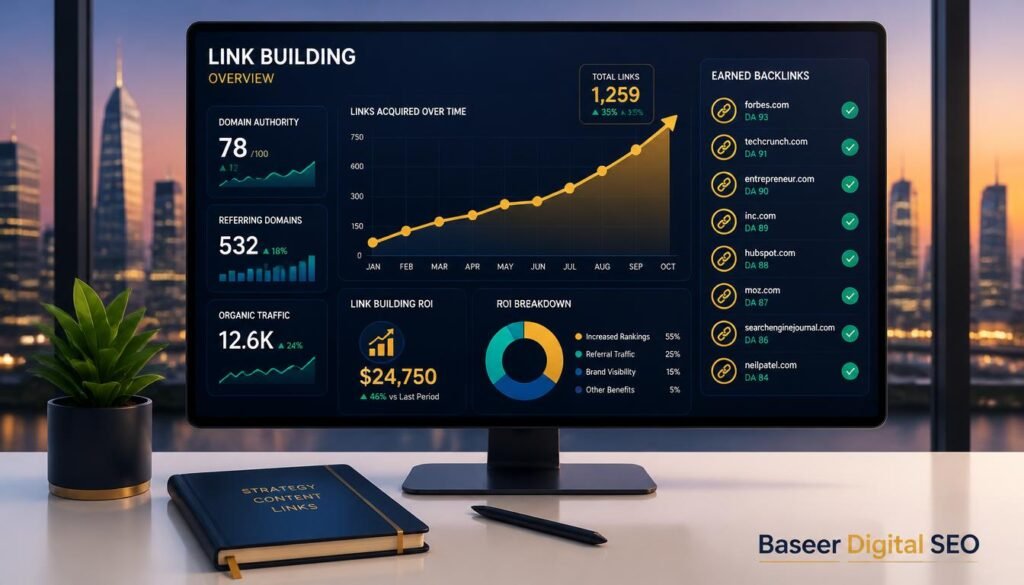
Good resource link building deserves proper tracking. Keep an eye on how many links you’ve earned and which pages they come from, how relevant those pages are, and the referral traffic showing up in Google Analytics 4. Watch ranking movement for the pages you’ve been building links to, your reply and placement rates, and any growth in branded searches over time.
Be careful about crediting a ranking jump to one link. Plenty of things move rankings, so judge trends across several months rather than a few days.
Conclusion: Building a Sustainable Resource Page Link Building Strategy
Resource page link building isn’t glamorous, and it won’t hand you quick wins. What it gives you is a dependable way to earn relevant, editorial links just by being useful. Build something worth recommending, find the pages where it belongs, vet them carefully, and send a short, honest message.
The people who get the most from it treat it as a habit, not a campaign. They keep improving their assets, keep a list of prospects warm, and track what actually changes. Add broken link building and a few other ethical link building strategies, and your backlink profile ends up resting on trust rather than shortcuts.
Starting from zero? Pick one resource you’re proud of, find ten relevant pages, and send ten thoughtful emails. You’ll learn more from that small experiment than from another week of reading.
Frequently Asked Questions
What Is a Resource Page in SEO?
It’s a web page that collects helpful links on one subject, such as tools, guides, organizations, or reading lists. For SEO, a link from one can be a relevant, editorial backlink that supports authority and brings in referral traffic.
How Do You Find Resource Pages for Link Building?
Use Google search operators like inurl:resources or intitle:"useful links" alongside your topic. Study competitor backlink profiles to see which resource pages already link to similar content, and browse universities, nonprofits, professional associations, and local government sites in your niche.
Is Resource Page Link Building White Hat?
Yes, when you do it honestly. Offering genuinely helpful content and asking politely is a white hat approach, while paying for links or using deceptive tactics moves it into risky territory.
What Is the Difference Between Resource Page Link Building and Broken Link Building?
Resource page link building asks a curator to add your content to a list because it’s relevant and useful. Broken link building means finding dead links on a page and offering your working content as the replacement. They overlap often, since checking a resource page for broken links is a natural way to start the conversation.


Leave a Reply