
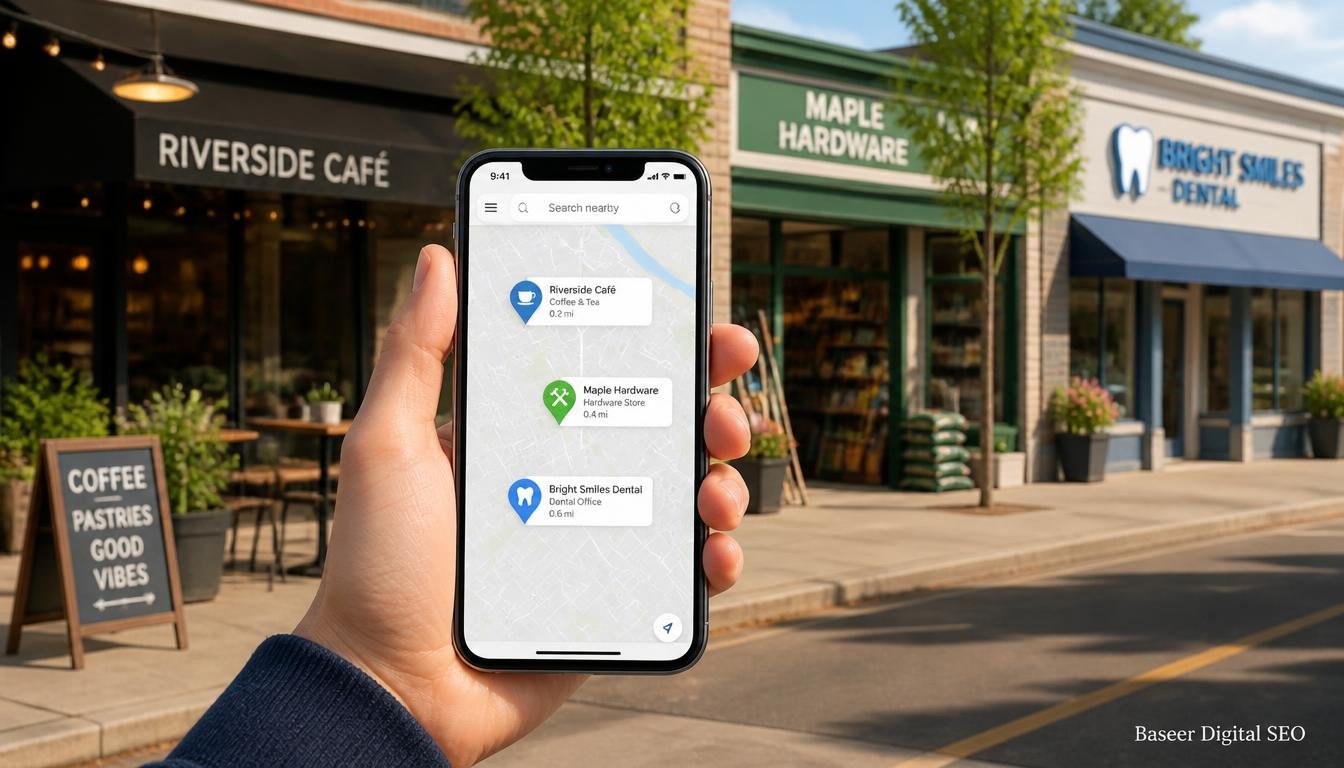
Someone in Austin types “emergency plumber near me” into their phone. A parent in Manchester searches for a bakery that does birthday cakes. A new homeowner in Toronto wants a dentist who’s open on Saturdays. Each of them gets a short list of businesses within seconds, and most will call one of the first few they see.
That’s Local SEO at work. It’s the practice of making your business easier to find when people search for products or services in a specific area. This guide walks through how it works, what to prioritize, and how to tell whether your effort is paying off. It’s written for small-business owners and marketers in the US, UK, and Canada, and you don’t need technical experience to follow it.
What Is Local SEO and Why Does It Matter?
Local SEO is a branch of search engine optimization focused on visibility in location-based searches. It covers searches that name a place (“bookkeeper in Leeds”), searches with “near me,” and searches where the engine assumes you want something nearby even though you didn’t say so.
If your business serves customers in a particular city, region, or service area, this is where much of your potential traffic comes from.
How Local SEO Helps Businesses Reach Nearby Customers
People searching locally usually want to act soon. They’re looking for opening hours, a phone number, directions, or a quote. That’s a different mindset from someone reading a how-to article, and it’s why local searches often turn into calls and visits quickly.
A small independent shop can’t outspend a national chain on advertising. It can, however, show up prominently for the neighborhood searches that matter to it.
Local Pack vs. Organic Search Results
When Google detects local intent, it often shows a map with three business listings, known as the local pack, above the standard results. Below that sit the regular organic listings, which are ranked mostly on website content and authority.
| Local pack | Organic results | |
|---|---|---|
| Main source | Google Business Profile | Your website pages |
| Key factors | Relevance, distance, prominence | Content, links, technical health |
| What searchers see | Name, rating, hours, photos | Title, URL, description |
You want to show up in both, and the work for each overlaps more than you might expect.
How to Build an Effective Local SEO Strategy
A solid local SEO strategy doesn’t need to be complicated. It needs to be consistent. Start by deciding who you’re trying to reach and where, then fix the biggest gaps first rather than doing a little of everything.
Understand Your Local Audience and Search Intent
Think about how your customers actually phrase their searches. A homeowner in Calgary might type “furnace repair” in January and “AC tune-up” in June. A tourist in Edinburgh may search “best fish and chips open now.” Intent changes with the season, the situation, and the person.
Talk to customers, read your reviews, and check the questions people ask on the phone. Those are free research.
Identify Your Main Local SEO Ranking Opportunities
Search your own services the way a customer would, from a phone, in your area. Note who appears in the local pack and what they do well: more reviews, better photos, clearer service pages.
Then compare against your own presence. Common gaps include an unclaimed profile, thin service pages, and inconsistent listings. Fixing these usually delivers more than chasing advanced tactics.
Google Business Profile Optimization Best Practices
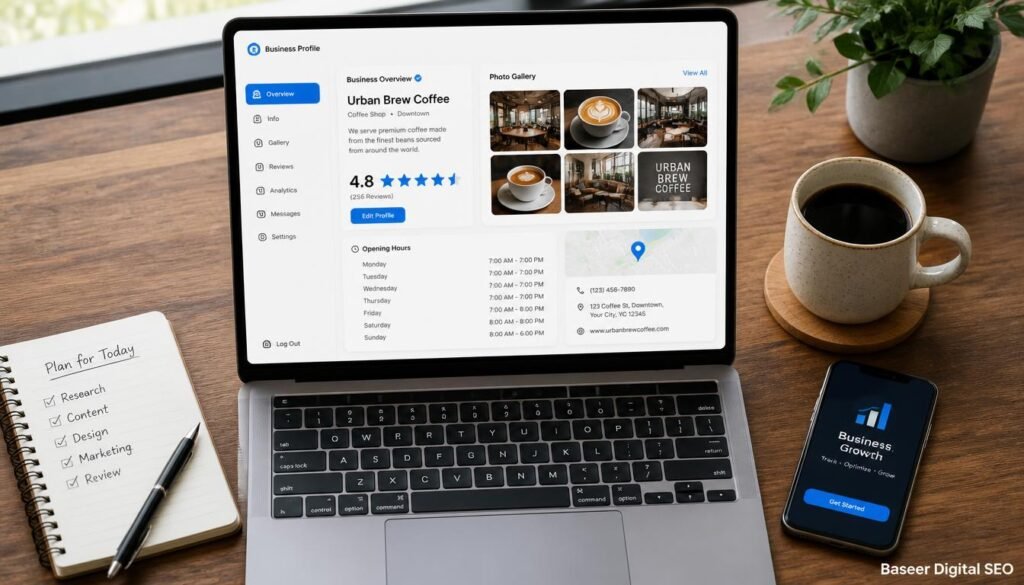
Your Google Business Profile (GBP) is the free listing that appears in Maps and local search. Careful Google Business Profile optimization is often the single highest-impact step for a local business, so it’s worth getting right.
Choose the Right Business Category
Your primary category tells Google what you are. Pick the most specific option that describes your main service. A “Personal injury attorney” profile will serve a law firm better than a generic “Lawyer” one if that’s the work it does.
Add secondary categories only if they’re genuinely accurate. Don’t pad the list.
Add Accurate Business Information, Services, and Photos
Fill in every field that applies:
- Business name exactly as it appears on your signage
- Address or service area, phone number, and website
- Accurate opening hours, including holiday changes
- A list of services with short descriptions
- Real photos of your premises, team, and work
Use your own photos where you can. A clear picture of your storefront helps people recognize it when they arrive.
Manage Customer Reviews and Business Reputation
Reviews influence both rankings and decisions. Customers read them closely, and a steady flow of recent, genuine feedback builds trust. Ask satisfied customers to leave a review, perhaps with a follow-up email or a card at checkout. Never offer payment for reviews or write fake ones, since that breaks Google’s rules and can backfire.
How to Respond to Positive and Negative Reviews Professionally
Reply to positive reviews with a short, personal thank-you. Mention something specific if you can.
For negative ones, stay calm and factual. Acknowledge the problem, apologize where it’s warranted, and offer to resolve it offline with a phone number or email. Avoid arguing in public. Future customers are reading your tone as much as the complaint.
How to Perform Local Keyword Research
Good local keyword research helps you match your pages to the words customers actually use. It isn’t about volume alone. A phrase searched 50 times a month can be worth more than one searched 5,000 times if the searchers are ready to buy.
Find Service-Based Keywords
Start with what you sell, described in plain language: “boiler repair,” “invisalign,” “wedding photographer.” Add the terms customers use rather than industry jargon. Autocomplete suggestions, “people also ask” boxes, and competitor menus are good sources.
Target Location-Based Search Terms
Combine services with places: city, neighborhood, county, province, or well-known area. “Roofing contractor in Brooklyn” and “roofers in Glasgow” are both locally framed. Spelling matters too. A Canadian audience may search for a “plumber in Vancouver,” while UK readers may use “plumber near Cardiff.”
Don’t stuff every town into one page. Reserve location terms for pages that truly serve that place.
Analyze Search Intent and Keyword Opportunities
Look at what ranks for a term. If the top results are service pages, you need a service page. If they’re comparison articles, a sales page won’t match the intent. Use that insight to decide which keywords to target and which to skip.
How to Choose Keywords for Individual Service Pages
Give each distinct service its own page and its own main keyword. A heating company might have separate pages for boiler installation, boiler repair, and annual servicing. Choose one primary phrase per page, add two or three close variations, and make sure no two pages compete for the same term.
Local Business Listings and Citation Building
Your website isn’t the only place customers find you. Directories, maps, and industry sites all feed information to search engines and help confirm that your business is real.
What Are Local Citations?
Local citations are online mentions of your business name, address, and phone number (often called NAP), usually on directories and listing sites. They don’t need a link to count. Think of them as digital references that help search engines verify who you are and where you operate. Strong local business listings on major platforms and relevant industry sites give you a reliable foundation.
Useful starting points differ by country. In the US, think Yelp, Apple Business Connect, Bing Places, and the Better Business Bureau. In the UK, options include Yell and Checkatrade for trades. In Canada, consider Yellow Pages Canada and Canadian chamber of commerce directories.
Keep Your Business Name, Address, and Phone Number Consistent
Use one exact version of your details everywhere. “St.” versus “Street” or an old phone number may look minor, but mismatches can confuse both search engines and customers. Create a simple document with your official details and copy from it each time.
Common Local Listing Mistakes to Avoid
- Leaving duplicate listings after a move or rebrand
- Using a tracking number on some sites and your main number on others
- Listing a virtual office or PO box as a storefront
- Ignoring unclaimed profiles that customers can’t correct
- Adding the wrong category on directory sites
Local Link Building Strategies That Work
Links from other websites act as endorsements. Local link building focuses on earning them from sources near you or relevant to your trade, and a few quality links beat dozens of weak ones.
Earn Backlinks From Relevant Local Websites
Look for natural opportunities. Local news sites, community blogs, school or charity pages, and neighborhood associations often link to businesses that contribute something. Sponsor a youth team, host a workshop, or publish a useful local resource, such as a seasonal maintenance checklist for homeowners in your region.
Find Competitor Backlink Opportunities
Use a backlink tool to see which sites link to competing businesses nearby. If a chamber of commerce, supplier directory, or local blog lists them, you may qualify too. Don’t copy blindly. Pick the sources that are genuinely relevant and approachable.
Build Relationships With Local Organizations and Publications
Introduce yourself to local journalists, business groups, and complementary businesses. A wedding florist and a photographer can recommend each other. A quick, helpful quote for a local news story can earn a mention. Relationships take time, but they produce links that are hard for competitors to replicate.

How to Improve On-Page SEO for Local Search
On-page SEO is everything you do on your own website to make pages clear to people and search engines. Strong local SEO optimization here supports the rest of your efforts.
Optimize Title Tags, Meta Descriptions, and Headings
Each page needs a unique title that names the service and place where relevant, for example “Boiler Repair in Leeds | Smith Heating.” Keep titles roughly within 60 characters and descriptions within about 150 so they don’t get cut off. Use one clear H1 per page and let subheadings organize the content naturally.
Create Helpful Local Service Pages
A good service page explains what you do, who it’s for, how it works, what it costs (even a range, such as £150–£300, $200–$400, or CAD 250–450), and how to book. Add local details only when they’re real: neighborhoods you serve, local regulations that affect the job, recent projects, and customer testimonials.
Improve Internal Linking and Image Optimization
Link related pages together so visitors and crawlers can navigate easily. A blog post about winter boiler problems should link to your repair page. For images, use descriptive filenames and alt text, compress files so pages load quickly, and use original photos where possible.
How to Avoid Duplicate or Thin Location Pages
Copying one page and swapping the city name creates thin content that rarely performs. If you build location pages, each one should have something unique: a real address or service area, local team members, photos, reviews, and relevant details about that community. If you can’t add that, it’s better to have a single strong page than ten weak ones.
Best Local SEO Tools for Small Businesses
You don’t need a large budget. A handful of tools covers most needs.
Google Business Profile and Google Search Console
Google Business Profile is free and shows how customers find you, including views, calls, and direction requests. Google Search Console, also free, reports which queries bring people to your website, which pages are indexed, and whether there are technical issues.
Ahrefs and Google Keyword Planner
Ahrefs is a paid platform useful for keyword research, competitor analysis, and backlink checks. Plans vary, so review current pricing in your own currency. Google Keyword Planner is free with a Google Ads account and gives search-volume ranges and ideas. Used together, they’re good for building your keyword list and spotting link opportunities.

How to Measure Local SEO Performance
What you measure should connect to business results, not just rankings. Rankings can fluctuate by location, device, and even the time of day.
Track Local Rankings, Website Traffic, and Leads
Check the queries and pages that bring visitors in Search Console, and compare organic traffic month over month. Record leads from forms, emails, and bookings. Use a rank-tracking tool that can check results from specific locations, since a search from your office may differ from one across town.
Monitor Calls, Directions, and Customer Conversions
Google Business Profile reports calls, website clicks, and direction requests. Ask new customers how they found you, and use call tracking carefully so it doesn’t disrupt your listings. Over time, these figures show whether visibility is turning into revenue.
Frequently Asked Questions About Local SEO
What Is Local SEO in Simple Terms?
It’s the work of helping nearby customers find your business online, mainly through Google Maps, local search results, and your website.
How Long Does Local SEO Take to Show Results?
Simple fixes, such as claiming a profile or correcting listings, can show an effect within weeks. Competitive markets and newer websites often take three to six months or more to see steady gains. It depends on competition, your starting point, and consistency.
Is Google Business Profile Important for Local SEO?
Yes. It’s one of the main sources of local pack visibility and a key way customers contact you. It isn’t the only factor, but ignoring it makes the rest much harder.
How Can a Small Business Rank Higher in Local Search Results?
Complete your profile, collect genuine reviews, keep your listings consistent, create useful service pages, and earn local links. Focus on being relevant, close to the searcher, and well regarded in the community.
What Is the Difference Between Local SEO and Traditional SEO?
Traditional SEO aims to rank pages for searches regardless of location. Local SEO targets searches with geographic intent and adds map listings, reviews, citations, and proximity to the mix.
Final Thoughts on Building a Successful Local SEO Strategy
The most effective approach is rarely the most complicated. Claim and polish your Google Business Profile, learn how your customers search, keep your details consistent, build helpful pages, and earn trust through reviews and local relationships.
Start with one improvement this week, such as checking that your listing is accurate, then keep going steadily. Local SEO rewards businesses that show up reliably for their community, and that’s something even the smallest shop can do well.



Leave a Reply